

SkaterTrainers Review: Safer, Faster Way to Learn Skateboard Tricks for All Ages
Introduction
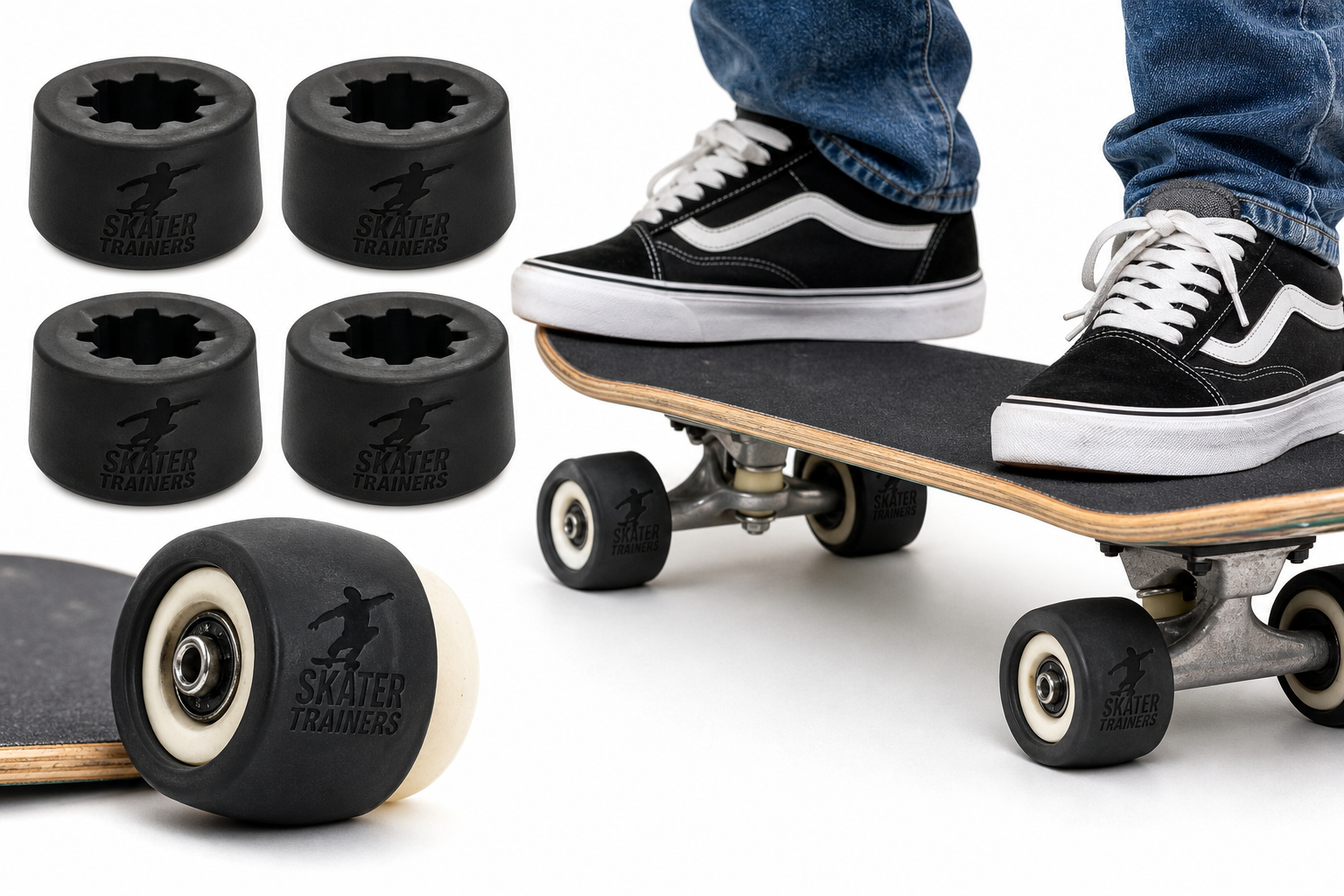
The SkaterTrainers skateboard accessory is designed to solve one of the biggest early frustrations in skateboarding: the board shooting out from under you while you’re trying to learn tricks. Sold as a set of four flexible rubber pieces that slip over your wheels, SkaterTrainers stop the board from rolling so beginners can focus on timing, balance, and foot placement.
Available around $28.99 on Amazon, they’re marketed as a simple way to learn ollies, kickflips, and other fundamental tricks faster, with less risk of hard falls. This review looks at how they work in practice, who will benefit most, and where the limitations show up.
Setup / Getting Started
One of SkaterTrainers’ biggest advantages is how little setup is required:
- No tools needed: Each piece is made from a stretchy rubber-like material that you pull over the wheel by hand.
- Fits standard trick boards: They’re intended for most standard skateboard wheel sizes used for street and park skating.
- Four-piece set: You get one SkaterTrainer for each wheel, turning a regular skateboard into a stationary training board.
Installation steps:
- Place your skateboard on its side so the wheels are accessible.
- Stretch one SkaterTrainer over a wheel, starting from one edge and working it around until it seats in the wheel’s center.
- Repeat for the remaining three wheels.
- Set the board back on the ground and verify it does not roll when you step on it.
Most users should be able to install a full set in a minute or two. Younger kids may need initial help stretching the rubber over the wheels, but once shown, they can usually manage it on their own.
Removing them is just as easy: peel them off the wheel and toss them into a backpack or pocket. Because there’s no modification to the board, you can quickly switch between practice with and without SkaterTrainers during a single session.
Daily Usage
In everyday practice, SkaterTrainers are best thought of as a technique and confidence trainer rather than a permanent accessory you skate with all the time.
Ideal use cases
- First tricks for beginners: Kids and teens trying their very first ollies, pop shuvits, or basic flip tricks.
- Adults returning to skating: Skaters who haven’t ridden in years and want to rebuild skills without taking heavy slams right away.
- Limited or uneven practice space: Driveways with slight slopes, garages, and small patios where the board would normally roll away.
With the wheels blocked from rolling, skaters can:
- Practice the pop and slide motion of an ollie repeatedly.
- Work on foot placement for kickflips and heelflips.
- Get comfortable bending knees and committing to the board without worrying it will shoot out.
Session flow
A typical practice session might look like this:
- Warm-up stationary: Put SkaterTrainers on and run through 20–30 reps of the trick, focusing on foot placement and timing.
- Transition to rolling: Take them off, try the same trick on flat ground with a gentle roll.
- Refine specific issues: If something feels off (board slipping, not committing), put them back on to isolate the movement.
This pattern of alternating between stationary and rolling practice is where the product makes the most sense. Used this way, SkaterTrainers act like training wheels: helpful early on, but not something you rely on permanently.
Performance & Reliability
Stability and feel
Once installed, SkaterTrainers significantly reduce rolling, especially on relatively smooth surfaces like driveways, sidewalks, or indoor flooring. The board feels more like a controlled platform than a moving vehicle, allowing skaters to:
- Commit more weight over the board without fear of kick-out.
- Focus on body mechanics instead of chasing the board after every failed attempt.
You should still expect some minor rocking or micro-movement, especially if the ground is uneven, but it is far more stable than a free-rolling board.
Durability
The rubber material is built to withstand repeated stretching over the wheels and the impact forces from trick attempts. Under normal use—practice in driveways, garages, and skate-friendly surfaces—they should last through many months (or more) of learning sessions.
As with most rubber training aids, potential long-term wear points include:
- Edges where they stretch over larger or harder wheels.
- Regular exposure to rough asphalt and debris.
- Being left outside in heat, cold, or direct sunlight.
For most beginner and intermediate skaters using them a few times a week, the material and design should be sufficient to cover the entire early learning phase.
Compatibility
SkaterTrainers are optimized for standard skateboard setups:
- Street/park boards with typical wheel diameters.
- Standard trucks and wheel widths.
Very large, soft cruiser or longboard wheels may not be ideal, and performance can vary. For the intended audience—kids, teens, and adults using a typical trick skateboard—the fit is generally straightforward.
What Works Well
-
Confidence building
The biggest benefit is psychological: beginners are more willing to commit to the motion of a trick when they’re not afraid of the board slipping out. This confidence can translate to faster progress once they move to rolling practice. -
Structured learning for beginners
SkaterTrainers encourage skaters to break tricks into repeatable steps: stance, pop, slide, and landing. That structure is especially helpful for younger skaters who might otherwise just randomly jump on the board. -
Useful for parents and gift-givers
For parents who don’t skate themselves, it’s hard to know how to support a child who wants to learn tricks. SkaterTrainers provide a tangible, easy-to-understand tool that makes practice sessions feel safer and more controlled. As a result, they work well as a gift for teen boys and girls who are serious about learning tricks, not just cruising. -
No permanent changes to the board
Because they slip on and off, there’s no need to adjust trucks, change wheels, or drill into the deck. Your board remains a standard skateboard when the trainers are removed. -
Good for tight or imperfect spaces
In small driveways, garages, and indoor areas where a rolling board would constantly hit walls or steps, SkaterTrainers make the most of limited space.
What Could Be Improved
-
Transition to real rolling conditions
While SkaterTrainers help with mechanics, they do not replace the need to practice tricks while actually moving. Some skaters may become too reliant on stationary practice if they don’t consciously make the effort to transition to rolling. -
Surface sensitivity
On very rough pavement or highly uneven surfaces, the stability can vary, and the rubber may wear faster. A clearer set of guidelines on optimal surfaces—and what to avoid—would be helpful. -
Size and wheel compatibility guidance
Although designed to fit most trick skateboards, there can be confusion about fit on larger wheels or non-standard setups. More prominent sizing charts or example setups would reduce uncertainty. -
Storage and carrying options
The trainers are small enough for a backpack or skate bag, but a basic included pouch or strap could make them harder to misplace and easier to keep together as a set.
Overall Impression
SkaterTrainers deliver on their core promise: making it easier and safer for beginners and returning skaters to practice key skateboard tricks without the board constantly shooting out from under them. They’re simple to install, durable enough for repeated practice sessions, and effective as a confidence-building tool.
They are not a replacement for learning tricks while rolling, and they work best when used as part of a mixed approach—stationary practice with SkaterTrainers followed by rolling attempts on flat ground. For kids and teens eager to land their first ollie or kickflip, and for adults who want a gentler re-entry into skateboarding, SkaterTrainers are a thoughtful, practical accessory.
If you’re setting up a young skater or buying a gift for someone who wants to go beyond simple cruising, this product offers a relatively low-risk way to make early trick practice safer, more structured, and more enjoyable.
For more details or to purchase, you can visit the product page on Amazon: https://www.amazon.com/dp/B01F49C0QS.