

Cupkin Animals Habitat 500+ Kids Sticker Book Review: Screen‑Free Travel Fun for Ages 2–8
Introduction
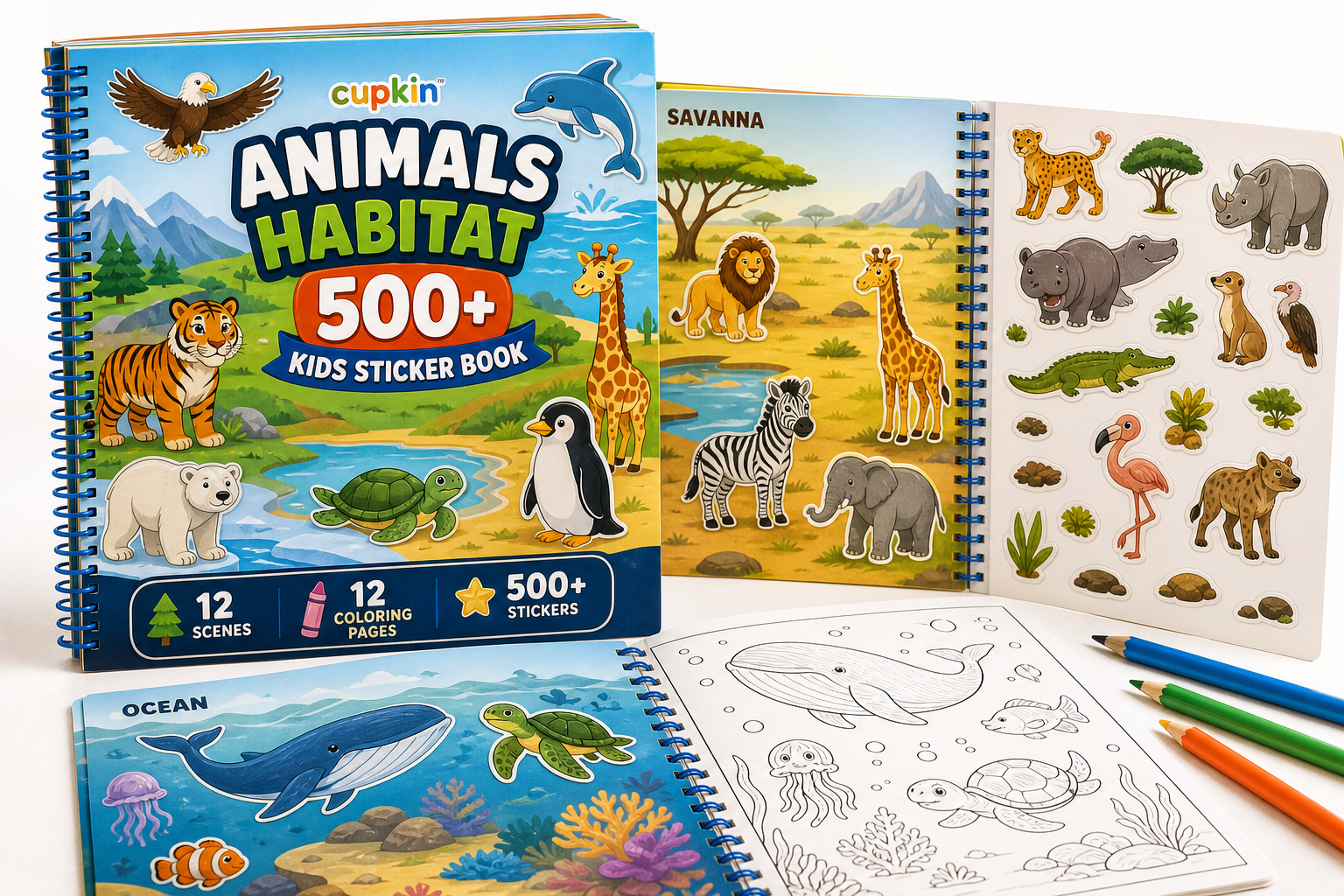
The Animals Habitat 500+ Kids Sticker Book by Cupkin is an all‑in‑one activity book built around animal habitats. It combines over 500 stickers with illustrated scenes and coloring pages in a portable format. Aimed at children roughly ages 2–8, it is positioned as a road trip and airplane travel essential that keeps kids engaged without screens.
Rather than loose sheets, the stickers and scenes are bound together, making it easier to toss into a backpack and use on the go. At around $16.98 on Amazon, it sits in the mid‑range for sticker and activity books, promising a balance of educational content, variety, and durability.
Typical Use Cases
Parents and caregivers are likely to reach for this book in a few main situations:
-
Airplane and Airport Time
- Keeping toddlers and young kids occupied during flights, layovers, and gate waiting areas.
- Providing a quiet, self‑contained activity that doesn’t require Wi‑Fi, sound, or extra supplies.
-
Road Trips and Everyday Car Rides
- Using the sticker scenes and coloring pages as car‑friendly activities.
- Rotating scenes so kids have something new to do over long drives.
-
At‑Home Quiet Time
- Independent play while caregivers cook, work, or care for siblings.
- Calm activities before bed or during screen‑free blocks.
-
Restaurants, Waiting Rooms, and Errands
- Compact entertainment for situations where children need to sit still but space is limited.
- An alternative to handing over a phone or tablet.
-
Early Learning and Themed Play
- Reinforcing animal names, habitats (forest, ocean, savanna, etc.), and simple categorization skills.
- Pairing with themed lessons in preschool, kindergarten, or homeschool settings.
Performance in Each Scenario
1. Airplane and Airport Use
For air travel, this sticker book performs well for several reasons:
- Self‑contained format: The spiral‑bound design keeps pages together and is easier for kids to hold on tray tables or laps than loose pads.
- Side‑by‑side layout: Stickers are arranged close to their matching scenes, reducing page‑flipping and the risk of losing sheets in cramped spaces.
- Low‑mess: No glue, scissors, or extra tools are needed—particularly important in tight airplane seats.
Potential considerations:
- Younger toddlers may still drop stickers or pages; a small zipper pouch for partially used sheets can help.
- Tray tables offer limited space, so it works best one child at a time.
2. Road Trips and Car Rides
In the car, the book offers a convenient alternative to screens:
- Lap‑friendly size: The bound book format is stable on a child’s lap or a travel tray.
- Repositionable (to a point) stickers: Many stickers can be gently lifted and moved if a child wants to redesign a scene, though they’re not fully reusable in the sense of vinyl cling decals.
Points to keep in mind:
- Very young children may find peeling stickers in a moving car slightly challenging, especially on bumpier roads.
- Some families may prefer to save sticker placement for rest stops or more stable situations and use the coloring pages during motion.
3. At‑Home Quiet Time
At home, the sticker book supports longer, more creative sessions:
- 12 scenes + 12 coloring pages: Kids can revisit favorite habitats and expand them with coloring, promoting both structured and open‑ended play.
- Fine motor practice: Peeling and placing stickers helps train pincer grasp, hand‑eye coordination, and spatial planning, particularly valuable for preschoolers.
- Sibling‑friendly: Multiple children can share by dividing scenes or alternating pages.
Limitations at home are modest: once all stickers are used, the primary replay value comes from the coloring pages and revisiting completed scenes, so some children may move through the book quickly.
4. Restaurants, Waiting Rooms, and Errands
In public, the book functions effectively as a compact, respectful activity:
- Quiet: There’s no sound component, which is considerate in shared spaces.
- Minimal footprint: It takes up little table or lap space compared with larger activity sets.
- Fast start/stop: Sessions can be short; kids can place a handful of stickers or color part of a page, then pause without setup or cleanup.
Parents should be aware that loose stickers can end up on tables, chairs, or clothing; guiding children to keep stickers in the book maintains courtesy and avoids leaving residue.
5. Early Learning and Themed Play
From an educational standpoint, the animal‑habitat focus offers several benefits:
- Vocabulary building: Children can learn and review animal names and basic habitat categories (e.g., desert vs. ocean vs. forest).
- Sorting and classification: Matching animals to the appropriate habitat scene reinforces early science concepts.
- Storytelling: Completed scenes naturally lend themselves to simple narratives ("Why is the penguin here? What is the lion doing?").
For structured learning, caregivers can:
- Prompt kids to group stickers by habitat before placing them.
- Ask open‑ended questions: “Which animals live in cold places?” or “Which animals might be awake at night?”
Strengths Across Scenarios
-
Travel‑Focused Design
The combination of spiral binding, side‑by‑side sticker sheets and scenes, and compact size makes it particularly effective for travel. It avoids the main pitfalls of loose sticker pads, which are easier to scatter or lose. -
High Sticker Count and Variety
With 500+ stickers, children have enough pieces to build dense, imaginative scenes rather than feeling limited to only a few animals per page. Variety helps keep interest high across multiple use sessions. -
Balanced Age Range (2–8 Years)
- Toddlers (2–3) can practice simple placement and name a few animals.
- Preschoolers (3–5) can begin matching animals to habitats and telling simple stories.
- Early elementary children (6–8) can focus more on composition, design, and detailed coloring.
-
Educational Value Without Feeling Like Homework
The habitat theme subtly introduces basic life science concepts alongside creative play, which can complement early learning curricula without requiring formal instruction. -
Low‑Mess, Screen‑Free Engagement
Because there are no electronic components, batteries, or liquids, it’s a dependable option when screens aren’t possible or desired (limited Wi‑Fi, low battery, or intentional screen breaks). -
Durability for an Activity Book
The spiral binding and heavier‑weight pages (compared with thin magazine‑style sheets) generally hold up well to use, especially if children do not aggressively bend or tear at pages.
Limitations Across Scenarios
-
Finite Lifespan Once Stickers Are Used
Like any traditional sticker book, once all 500+ stickers have been placed, the main novelty is gone. Coloring pages continue to have value, but the core "sticker activity" is not endlessly reusable. -
Not Fully Reusable Stickers
The stickers can often be repositioned shortly after placement, but they are not marketed as fully reusable or static‑cling. Over time, repeated peeling may reduce adhesion or cause tearing, limiting the number of redesigns. -
Age‑Dependent Independence
- Children at the younger end (2–3) may still need help peeling stickers and turning pages.
- Fine‑motor skill development is part of the benefit, but it also means supervision or assistance may be necessary at first, especially in moving vehicles.
-
Theme Specificity
The focus on animal habitats is a strength for many families, but children uninterested in animals or nature may lose interest more quickly than they would with a more general interest or character‑based book. -
Space Constraints in Tight Seating
Even though the book is compact, any sticker activity requires some elbow room. On very crowded flights or in small restaurant booths, it may still feel cramped for some children.
Verdict
The Animals Habitat 500+ Kids Sticker Book by Cupkin is a thoughtfully designed activity book that targets a real need for portable, screen‑free entertainment. With over 500 stickers, 12 scenes, and 12 matching coloring pages, it offers ample content for flights, road trips, and quiet time at home.
Its key strengths are its travel‑friendly format, educational animal‑habitat theme, and broad age suitability from toddlers through early elementary. Its main trade‑offs are the finite nature of sticker‑based activities and the fact that stickers are not truly reusable long‑term.
For families seeking a compact, low‑mess activity that supports fine motor skills and early science concepts, particularly for use on airplanes and road trips, this Cupkin sticker book represents solid value at around $16.98. It is best viewed as a self‑contained activity kit for a trip or season of use, rather than a toy with indefinite replay value.