

Airbition Talking Flash Cards Review: A Compact Montessori Language Kit for Toddlers
Introduction
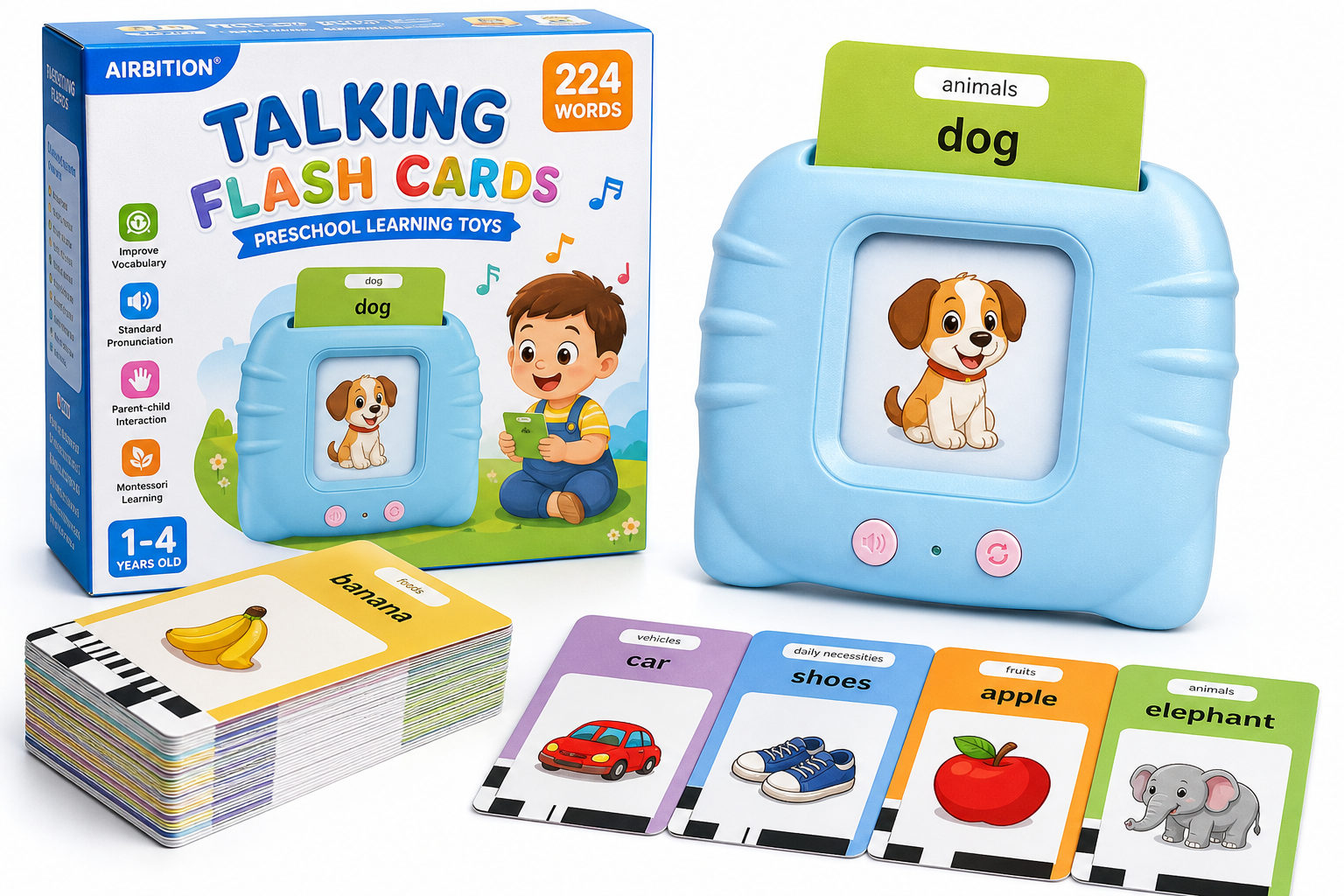
Airbition Talking Flash Cards for Toddlers Ages 1‑4, 224 Words English (Blue) is a compact electronic flash-card reader paired with a deck of illustrated cards designed to speak each word aloud when inserted. Positioned as a Montessori‑inspired language learning and sensory kit, it targets toddlers roughly between 1 and 4 years old who are building basic vocabulary and early speech.
Unlike traditional flash cards that rely entirely on a caregiver to read them, this device adds audio feedback: the reader recognizes each card and pronounces the associated word, often accompanied by simple sound effects. That combination of visual cues, spoken words, and tactile handling aims to support early language development, especially for children who benefit from auditory repetition or more independent play.
Below, we look at how this set performs in real‑world scenarios, where it shines, and where parents or educators may want to consider its limits.
Typical Use Cases
1. Everyday Home Learning for Toddlers
For most families, the primary use is casual language learning at home. Caregivers sit with the child, insert cards, and name each item together. Over time, toddlers begin to anticipate and repeat the words.
Typical activities include:
- Naming common objects, animals, and foods
- Matching real‑life objects to the card (e.g., toy cat to "cat" card)
- Practicing pointing and labeling: “Where is the apple?”
2. Early Speech and Vocabulary Support
The talking function and repetition can also support early speech and vocabulary growth. While it’s not a replacement for professional therapy, it can be a useful adjunct for:
- Children who are late talkers
- Kids who benefit from hearing clear, consistent pronunciation
- Practice with single‑word utterances before sentences
3. Independent Play with Supervision
Once toddlers understand how the reader works, many will enjoy inserting and removing cards themselves. This enables semi‑independent play where they:
- Explore new words at their own pace
- Repeat favorite cards multiple times
- Practice cause‑and‑effect (insert card → hear word)
Supervision is still recommended, especially for younger children, to prevent card bending or chewing.
4. On‑the‑Go Learning and Travel
Because the reader is pocket‑sized and rechargeable, it’s also suited to travel:
- Quiet learning during car rides
- Simple entertainment in waiting rooms or at restaurants
- Easy to pack a subset of cards rather than the full deck
Caregivers can carry a small stack of cards in a pouch, making it a portable learning option.
5. Preschool, Daycare, or Therapy Room
In group settings, teachers or therapists can use the set for:
- Small‑group vocabulary activities
- Turn‑taking games (each child chooses a card to insert)
- Themed lessons (e.g., animals today, foods tomorrow)
The self‑voicing cards reduce teacher talk time while still keeping language rich and engaging.
Performance in Each Scenario
Home Learning with Caregiver
In a one‑on‑one setting, the Airbition talking flash cards work particularly well. The device is simple: insert a card, listen to the word, and repeat. Parents can extend play by asking open‑ended questions ("What sound does this animal make?"), or by connecting words on the cards to real objects around the house.
For young toddlers closer to age 1, adults will be doing most of the handling and narration. As children approach 2–3 years, they typically become more active participants—selecting cards themselves, repeating words, and making associations.
Speech and Language Practice
For basic speech practice, the clear recorded voice and repeatable stimuli are big advantages. Children can hear the same word multiple times without the adult having to repeat it endlessly. This consistency is helpful if you’re trying to:
- Reinforce articulation of specific sounds
- Introduce new nouns in categories (animals, foods, vehicles)
- Build receptive vocabulary (understanding words) even before expressive speech (saying them)
The fixed 224‑word set covers a broad, but not exhaustive, range of common toddler vocabulary. That is usually sufficient for early learners and basic speech enrichment.
Independent or Semi‑Independent Play
Once children understand the insert‑and‑play mechanism, many will treat this as a toy they can operate themselves. The audio feedback is immediate, which encourages experimentation ("What does this card say?").
In this scenario, the product performs best when:
- The play space is organized so cards are easy to see and choose
- The number of cards offered at once is limited to avoid overwhelming the child
The main constraint is card durability and the potential for cards to be scattered or bent. While the cards are typically sturdy enough for normal use, enthusiastic toddlers may still manage to crease or damage some over time.
Travel and On‑the‑Go Use
For travel, the compact reader and relatively light deck of cards make this a practical choice. Caregivers can bring only a selection of favorite or topical cards (e.g., animals for a zoo trip) to save space.
Performance considerations on the go:
- The rechargeable battery can last multiple sessions between charges.
- Volume is generally sufficient for a car backseat but may be harder to hear in very noisy public spaces.
- Small parts (individual cards) need careful storage to avoid loss.
Classroom or Therapy Setting
In preschool or therapy contexts, the Airbition talking flash cards can serve as a motivating tool:
- Children enjoy taking turns inserting cards.
- The consistent, neutral pronunciation can support multi‑child groups.
However, because the reader is designed for one card at a time, it’s best suited to small‑group work rather than whole‑class instruction. Professionals may also want to supplement with other materials for more complex language goals (phrases, sentences, social language).
Strengths Across Scenarios
1. Simple, Toddler‑Friendly Operation
A key strength is how straightforward the device is to use:
- Insert card → hear word (and sometimes a related sound)
- No complicated menus or apps
- One main interaction that even young toddlers can master over time
This simplicity reduces setup time and makes it approachable for both children and caregivers.
2. Multisensory Learning Experience
The combination of:
- Colorful images
- Spoken words
- Physical card manipulation
creates a multisensory experience that aligns with many Montessori‑style principles. Children are not just passively watching a screen; they are touching, seeing, and hearing in a coordinated way.
3. Broad, Structured Vocabulary Set (224 Words)
With 224 English words, the set covers a wide range of early‑childhood vocabulary, often grouped into intuitive themes such as:
- Animals and nature
- Foods and household items
- Vehicles and objects from daily life
This breadth allows caregivers to tailor lessons to the child’s interests and developmental stage.
4. Encourages Repetition Without Screen Time
Toddlers often crave repetition, which can be tiring for adults and is a well‑known challenge with screen‑based learning. Here, children can:
- Replay favorite cards independently
- Hear consistent pronunciation each time
All of this happens without exposure to screens, which many caregivers prefer for very young children.
5. Portable and Rechargeable
The pocket‑sized reader and USB‑rechargeable battery make the product suitable for:
- Daily use at home without constant battery changes
- Easy packing for travel or visits to grandparents
This portability increases the likelihood that families will use it regularly instead of leaving it on a shelf.
6. Versatile for Different Ages Within 1–4 Range
While marketed for ages 1–4, its value shifts as children grow:
- Around 1–2 years: primarily exposure and listening
- Around 2–3 years: labeling, naming, and simple question‑answer
- Around 3–4 years: categorizing, simple games, and using words in short phrases
That developmental flexibility extends the useful lifespan of the toy.
Limitations Across Scenarios
1. Fixed Content and Vocabulary
The biggest structural limitation is the fixed 224‑word deck. You cannot:
- Add your own custom cards
- Change the audio to record your voice or new vocabulary
For many families this is fine, but caregivers looking for fully customizable language sets or minority languages will find this limiting.
2. Card Size and Potential Wear
The cards are sized for little hands, which is helpful for grip but means:
- They can be easier to misplace
- Very young toddlers may bend or mouth them
With regular use, some wear is expected, especially in high‑traffic cards (favorite animals and foods).
3. Not a Standalone Speech Therapy Solution
Although the product is often described as a pocket speech therapy tool, it is best viewed as supportive, not a substitute for professional evaluation or therapy. Children with significant speech or language delays will still need guidance from a speech‑language pathologist; this device can only reinforce basic vocabulary, not diagnose or address complex communication needs by itself.
4. Limited Complexity of Language
The focus on single words means the set is strongest for early vocabulary building. It does not:
- Model full sentences
- Teach grammar
- Guide conversational turn‑taking beyond basic labeling
Older preschoolers may outgrow it once they move beyond single‑word learning, at which point more advanced materials will be necessary.
5. Audio Volume and Environment
While the recorded sound is generally clear, performance can vary by environment:
- In quiet rooms, the volume is adequate.
- In loud or echoing spaces (busy restaurants, playgrounds), it may be harder for children to focus on the spoken word without adult support.
This isn’t unique to this product, but it is worth considering if you plan to use it mainly outside the home.
Verdict
The Airbition Talking Flash Cards for Toddlers Ages 1‑4, 224 Words English Blue stands out as a compact, easy‑to‑use Montessori‑style language kit for early learners. Its strengths lie in:
- Simple insert‑and‑play operation
- Multisensory, screen‑free learning
- Broad, age‑appropriate vocabulary coverage
- Portability for home, travel, and small‑group settings
At the same time, families should be aware of its limitations: the content is fixed, the cards require some care to avoid damage, and it focuses on single‑word vocabulary rather than more advanced language skills.
For parents and caregivers seeking a first talking flash card set to support everyday vocabulary practice, early speech development, and engaging, screen‑free play for ages 1–4, this Airbition kit is a well‑rounded option. It is especially suitable for households that value hands‑on learning and want a device simple enough for toddlers to operate—yet structured enough to anchor consistent language practice over months of use.