

Project Hail Mary: A Novel That Blends Hard Science with Human Stakes
Introduction
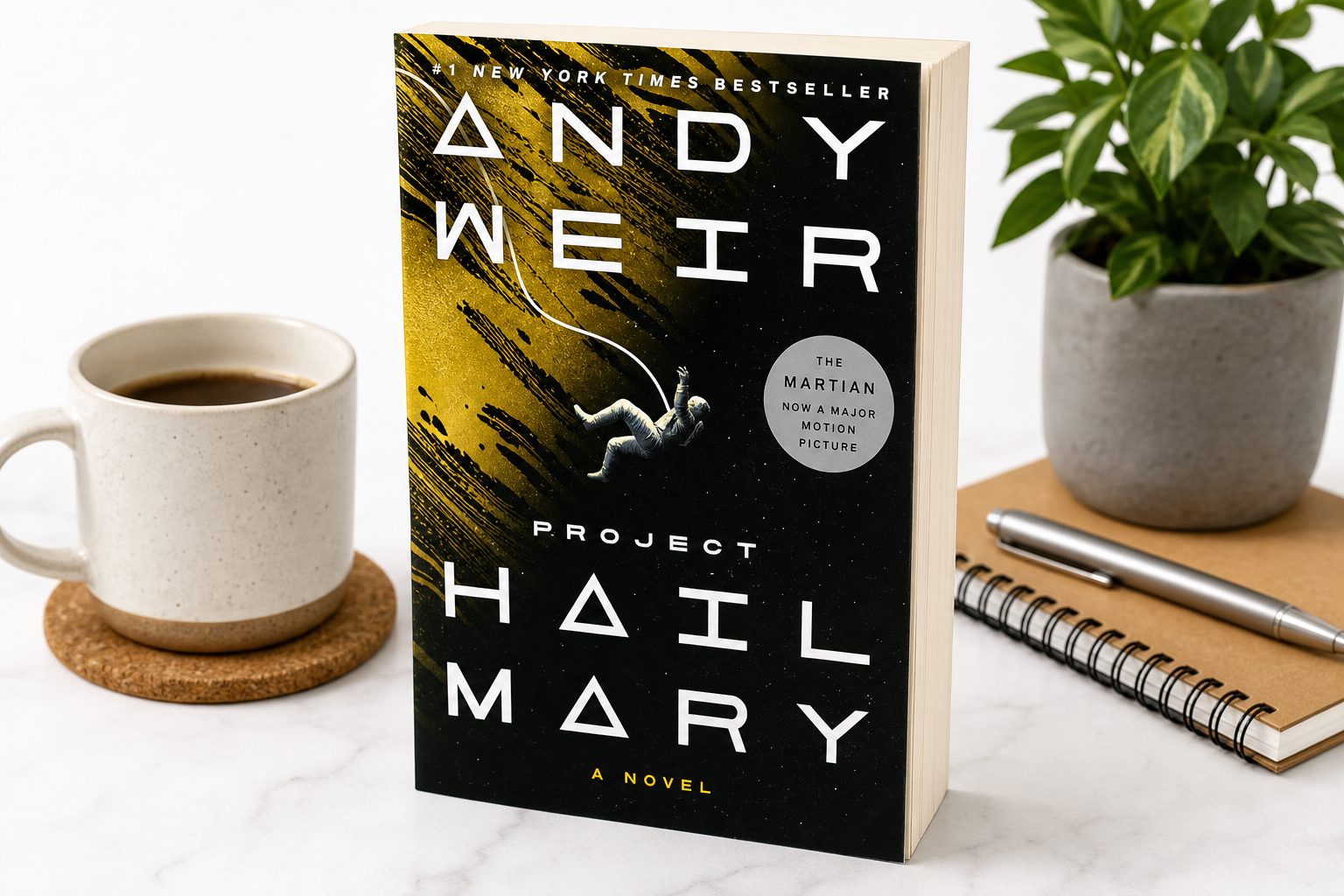
Project Hail Mary: A Novel by Andy Weir follows Ryland Grace, a lone astronaut who awakens on a spacecraft with no memory of who he is or why he is there. As his memories return, he discovers he is the sole surviving member of a last‑chance mission to save Earth from an extinction‑level threat. The book combines meticulous problem‑solving, step‑by‑step scientific reasoning, and an unexpectedly warm first‑contact storyline.
This edition (ISBN 0593135229) is the paperback tie‑in to the recent film adaptation, offering the full original narrative for readers who may be arriving from the movie or from Weir’s earlier work such as The Martian.
From a product‑style perspective, it is useful to think of Project Hail Mary as a reading "tool" aimed at readers who enjoy:
- Hard science fiction with detailed, plausible‑feeling technology
- Survival narratives and high‑stakes problem‑solving
- A mix of suspense, humor, and earnest emotional beats
If you are considering purchasing a copy from the product page at $13.88, the following sections break down how the novel performs in different real‑world reading scenarios.
Typical Use Cases
1. Casual Leisure Reading
Many readers will approach Project Hail Mary simply as a leisure read: something engaging to pick up in the evenings or on a vacation.
Typical goals in this use case:
- Be consistently entertained with a fast‑moving plot
- Experience a blend of tension and humor
- Follow an accessible, self‑contained story without needing prior background
2. Book Club Selection
The novel has become a popular choice for book clubs because it pairs a propulsive plot with discussable themes.
Typical goals:
- Stimulate conversation about ethics, sacrifice, and cooperation
- Compare book vs. film adaptation choices
- Offer both STEM and non‑STEM readers something to latch onto
3. STEM‑Friendly Classroom or Reading Group
Because the book leans into real physics and engineering concepts, it can be used as an informal teaching or enrichment tool in high school or undergraduate settings.
Typical goals:
- Spark interest in physics, astronomy, and engineering
- Provide approachable examples of scientific method and back‑of‑the‑envelope calculations
- Encourage critical thinking about what is realistic vs. speculative
4. Fans of Hard Science Fiction
Readers who already enjoy technically detailed science fiction—such as The Martian, Seveneves, or The Expanse—often look for rigorous world‑building and believable problem‑solving.
Typical goals:
- Assess the internal consistency of the story’s science
- Enjoy intricate, stepwise solutions to seemingly impossible problems
- Explore first contact and xenobiology framed through a scientific lens
5. Readers Coming from the Film Adaptation
With the recent movie adaptation, a new audience is encountering Project Hail Mary for the first time. Many will come to the novel to get deeper context than a two‑hour film can provide.
Typical goals:
- Fill in technical and character details abbreviated in the movie
- Understand the protagonist’s inner monologue and decision‑making in greater depth
- Compare structure, pacing, and tone between page and screen
Performance in Each Scenario
1. Casual Leisure Reading Performance
For leisure reading, Project Hail Mary performs strongly if you enjoy science‑driven plots:
- Engagement: The opening amnesia scenario and slow reveal of the mission’s stakes create immediate narrative momentum.
- Readability: Weir’s conversational first‑person style and short sections keep the pages turning.
- Tension curve: Alternating between present‑day crisis on the ship and flashbacks to Earth keeps the stakes clear and the pacing varied.
However, the frequent technical digressions may feel dense for readers who prefer character interactions over problem‑solving.
2. Book Club Selection Performance
As a book‑club pick, the novel offers several discussion vectors:
- Ethics and sacrifice: The recruitment process for the mission, and decisions made under extreme pressure, can provoke debate about consent, duty, and the value of individual lives vs. civilization.
- First contact: The relationship between Ryland and the alien character invites conversation about communication, empathy across species, and what "cooperation" looks like when survival is on the line.
- Memory and identity: Ryland’s amnesia raises questions about responsibility for past actions and how much our memories define who we are.
The main challenge for book clubs is that some members may find the technical passages daunting, while others may want even more detail. Moderators may need to steer discussion so both groups feel included.
3. STEM‑Friendly Classroom or Reading Group Performance
In educational or enrichment settings, Project Hail Mary is particularly effective:
- Scientific method in action: The book repeatedly shows Ryland forming hypotheses, designing experiments, and revising conclusions based on results.
- Order‑of‑magnitude thinking: Many of the solutions depend on approximate calculations and estimation—useful habits for budding scientists.
- Clear delineation of known vs. speculative: While Astrophage and some technologies are invented, much of the orbital mechanics and physics is grounded closely enough in reality to be teachable.
Teachers can easily extract problem sets or discussion prompts around energy budgets, orbital transfers, time dilation approximations, and communication protocols. The primary limitation is that, as a novel, it is optimized for narrative rather than for formal pedagogy, so instructors must curate specific excerpts.
4. Performance for Hard SF Fans
For readers who prioritize scientific rigor, the book largely delivers:
- Technical depth: Extensive attention is given to propulsion, life‑support constraints, stellar physics, and the properties of Astrophage.
- Consistency: Solutions rarely come from nowhere; they develop logically from constraints established earlier in the narrative.
- Problem density: The plot structure is almost episodic in the sequence of engineering crises and solutions, echoing classic "puzzle‑driven" SF.
Some hard‑SF readers may scrutinize the more speculative biology or the feasibility of certain energy requirements, but these elements typically fall within the genre’s accepted suspension‑of‑disbelief zone. If absolute realism is a requirement, you may view certain aspects as optimistic extrapolation rather than strict prediction.
5. Performance for Readers Coming from the Film
If you discovered Project Hail Mary through the movie, the novel functions as an expanded edition of the story world:
- Richer internal monologue: Ryland’s thought processes, doubts, and small comedic asides are far more visible on the page.
- Additional problem‑solving steps: The book often walks through intermediate calculations and failed approaches that the film condenses or omits.
- More world‑building: Political, social, and logistical details surrounding "Project Hail Mary" on Earth receive more attention, giving added context to the mission’s urgency.
The trade‑off is time: reading through all of that detail requires significantly more investment than the film’s runtime, which may or may not match what you are looking for after watching the adaptation.
Strengths Across Scenarios
-
Compelling High‑Concept Premise
The combination of a lone astronaut, an existential solar threat, and a mysterious alien partner provides a hook that works well for casual readers, book clubs, and SF veterans alike. -
Balanced Tone: Serious Stakes, Light Delivery
Even when the subject matter is dire, the narration often remains wry and approachable. This lowers the barrier for readers who might otherwise be intimidated by the hard‑SF label. -
Clear, Step‑by‑Step Explanations
For educational use and for readers who enjoy understanding "how things work," Weir’s tendency to explain the reasoning behind solutions is a major strength. -
Memorable Relationship at the Core
The central human‑alien friendship provides an emotional throughline that grounds the technical content, giving book clubs and casual readers something character‑driven to discuss. -
Standalone, Self‑Contained Story
The novel does not depend on a series; readers can pick up this single volume, finish it, and feel they have experienced a complete arc.
Limitations Across Scenarios
-
Density of Technical Detail
Readers who prefer minimal science in their science fiction may find some passages slow or overly expository, especially in the middle sections where multiple engineering problems stack up. -
Character Focus Primarily on the Protagonist
While the main relationship is well‑developed, side characters—especially those in Earth‑based flashbacks—can feel more functional than deeply explored. For readers seeking complex ensemble casts, this may be a drawback. -
Plausibility vs. Pacing Trade‑offs
To keep the story moving, some logistical and societal implications of the global crisis are sketched rather than fully developed. Readers looking for an exhaustive socio‑political treatment of a near‑extinction event may find this aspect light. -
Emotional Register
The same voice that keeps technical material digestible can sometimes undercut heavier emotional beats, depending on your taste. Some readers report being deeply moved; others feel slightly distanced by the constant humor. -
Length and Time Commitment
At several hundred pages, the book represents a significant time investment. For very casual readers or tight classroom schedules, this may limit its practicality, even if the cost at $13.88 feels reasonable from a value‑per‑page standpoint.
Verdict
Project Hail Mary: A Novel is a strong choice if you are looking for:
- A modern hard‑science‑fiction story with clear, engaging explanations
- A survival narrative driven by ingenuity and problem‑solving
- A memorable and surprisingly heartfelt exploration of cooperation across species
It is less ideal if you:
- Prefer character drama with minimal technical explanation
- Want a broad, multi‑perspective treatment of global catastrophe rather than a tightly focused, mission‑level story
- Dislike first‑person, voice‑driven narration
As a "product," this paperback edition offers a complete, re‑readable story that can serve multiple roles: a gripping leisure read, a thought‑provoking book‑club choice, or a springboard for STEM‑oriented discussions. If those use cases match what you are seeking—and you are comfortable with a substantial page count—the value proposition at $13.88 is strong, especially for readers who enjoy both science and story in equal measure.