

Mini Mic Pro (Latest Model) Review: Compact Wireless Lavalier Kit for Mobile Content Creators
Product Context
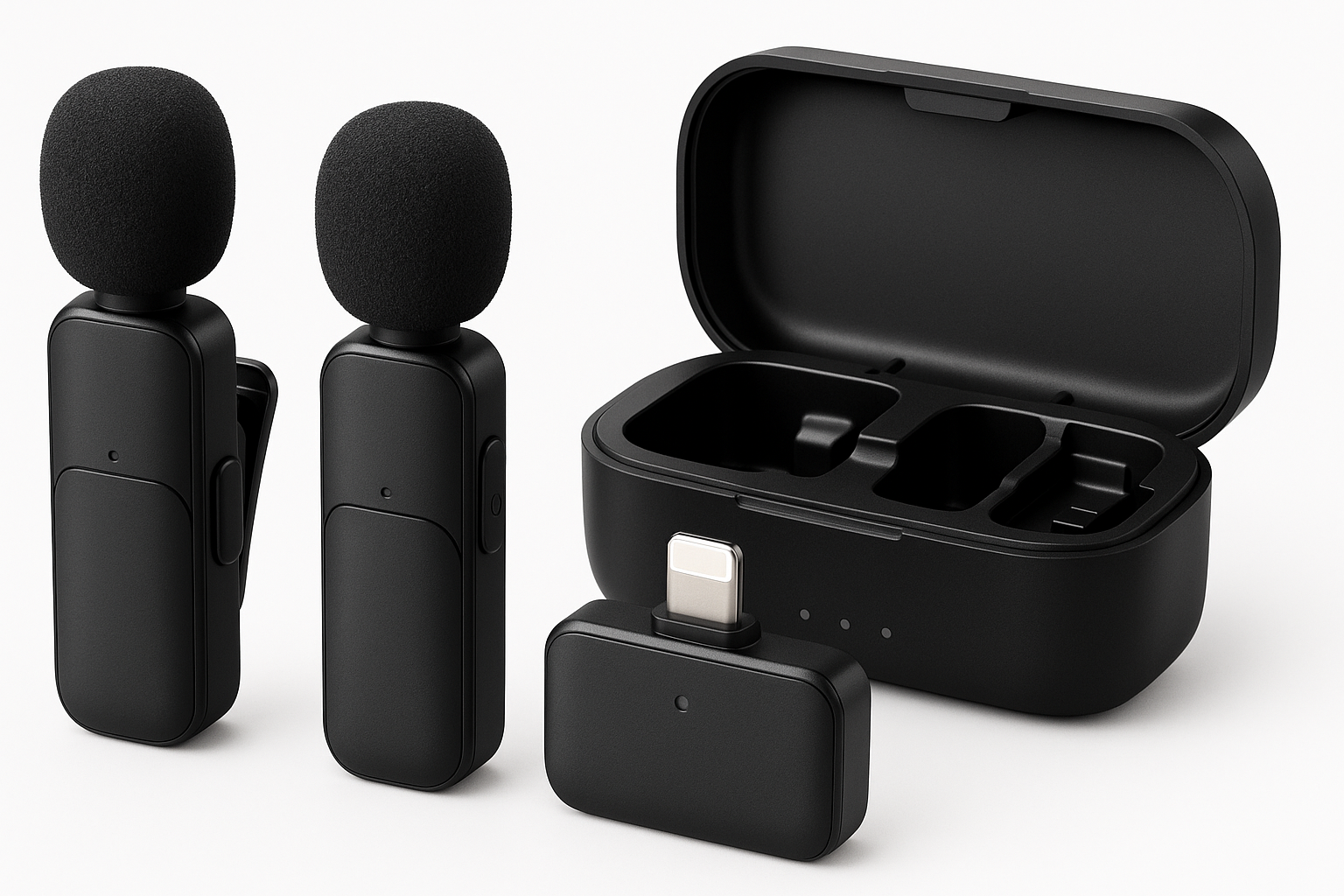
The Mini Mic Pro (Latest Model) is a wireless lavalier microphone kit aimed squarely at mobile content creators who record primarily on phones and tablets. It comes as a 2-pack of clip-on transmitters with a compact receiver that plugs directly into your iPhone, iPad, or Android device (via Lightning or USB‑C, depending on the specific package/adapter). The system is designed as a step up from no‑name budget mics while staying accessible to beginners who don’t want to deal with mixers, XLR cables, or complex camera setups.
Typical use cases include:
- TikTok, Instagram Reels, and YouTube Shorts
- Vlogging and travel videos
- Interviews and two‑person talking-head content
- Casual podcasting and voiceovers recorded directly to a phone
- ASMR, product demos, and online teaching/Zoom-style sessions
The promise is crystal-clear, low-latency audio in a pocketable form factor that you can toss into a bag alongside your phone or tablet, with plug‑and‑play setup and minimal technical friction.
Feature Breakdown
Dual Transmitters (2-Pack Lavalier Design)
One of the biggest selling points is the inclusion of two lavalier transmitters in a single kit. This allows:
- Two on‑camera speakers with separate mics
- Redundancy if you’re a solo creator but want a backup mic
- A/B mic placement (e.g., one on your shirt, one nearer to a sound source)
Each transmitter is a small, clip-on bodypack with a built‑in microphone, so you don’t need additional wired lavs dangling from your clothing.
Wireless 2.4 GHz Transmission
The Mini Mic Pro uses 2.4 GHz digital wireless transmission, the same general band used by many modern consumer wireless mic kits. The marketing emphasizes:
- Stable, low‑latency audio
- Good resistance to everyday interference in typical indoor and outdoor settings
- A practical working distance suited for run‑and‑gun smartphone shooting
In practice, 2.4 GHz is best for line‑of‑sight work; walls and crowds can degrade performance, so it’s most reliable for typical creator scenarios: filming at arm’s length up to moderate distance, simple walk‑and‑talk shots, or interviews across a small room.
Plug-and-Play Phone Integration
A key advantage of this kit is direct connection to phones and tablets without a separate audio interface:
- Lightning / USB‑C receiver (depending on the exact variant and adapter) plugs into an iPhone, iPad, or Android device.
- Most users can record straight into the default camera app or common social media apps that respect external mics.
This significantly simplifies the workflow for creators who don’t want to manage TRRS adapters, inline preamps, or USB audio dongles.
Battery and Charging Case (on Some Bundles)
Several retailer listings for Mini Mic Pro highlight a charging case that stores and charges both transmitters and the receiver between shoots. While exact runtime can vary with usage and firmware, the overall design goal is:
- Multiple hours of continuous operation on a single charge
- The ability to top up mics between takes simply by dropping them back into the case
For mobile shooting days, this is crucial: you’re far less likely to end up with a dead mic mid‑session if the kit lives in a charged case.
Noise Reduction and Voice Clarity
The Mini Mic Pro’s marketing leans heavily on “crystal clear recording” and noise reduction technology. This typically includes:
- DSP-based background noise suppression
- Tuning that emphasizes speech intelligibility
- A cardioid or omni capsule optimized for close‑mic spoken voice
For office, bedroom, or quiet outdoor environments, this helps voices cut through and provides a noticeable upgrade over built‑in phone microphones, especially at arm’s length or farther.
Broad Device Compatibility
Out of the box (or with the included adapters, depending on the configuration), Mini Mic Pro is intended to support:
- iPhone models with Lightning or USB‑C
- iPad models with Lightning or USB‑C
- Many Android phones and tablets with USB‑C
This makes it attractive if you or your collaborators swap between devices, or if you plan to upgrade phones soon and don’t want your mic to become obsolete immediately.
Performance Insights
Audio Quality
In real‑world use, Mini Mic Pro produces audio that is cleaner and more present than typical onboard phone microphones:
- Voices sound closer and more intimate, thanks to the mic being on the speaker’s chest rather than at arm’s length.
- Reduced room echo and background noise improve the sense of professionalism in talking‑head videos.
- For social media platforms (TikTok, Shorts, Reels), the clarity is more than sufficient and often comparable to more expensive entry‑level wireless systems when used in typical creator environments.
It’s not on the same level as high‑end professional wireless systems paired with studio lavaliers, but for the target audience and price bracket, the performance is strong.
Wireless Stability and Range
The 2.4 GHz link is generally solid for short to moderate distances in line‑of‑sight:
- Walking vlogs with the phone held out on a selfie stick work well.
- Interview setups within a small room or modest studio space are well within the system’s comfort zone.
As with most compact 2.4 GHz kits, you can expect performance to decline if you:
- Put multiple walls between the mic and receiver
- Work in extremely congested RF environments (busy trade shows, heavily populated Wi‑Fi spaces)
For typical creator scenarios—especially solo or two‑person talking‑head content—it’s more than adequate.
Latency and Sync
Latency is low enough that lip sync remains accurate in most mobile apps. You shouldn’t notice any mismatch between video and audio when recording directly to your phone’s camera app or popular social platforms, which is crucial for creators who want to publish quickly without post‑production fixes.
Usability
Setup and Everyday Workflow
One of the biggest strengths of the Mini Mic Pro is how simple it is to get started:
- Charge the case and mics before your first use.
- Plug the receiver into your iPhone, iPad, or Android device.
- Power on the transmitters (they often auto‑pair with the receiver).
- Clip the mic to your shirt or collar and hit record in your app of choice.
There’s no need to manage channels, frequencies, or gain staging if you’re a casual user; most people can treat this kit as a simple extension of their phone.
Controls and Indicators
The transmitters and receiver typically include:
- Power/pair buttons
- LED indicators for pairing and battery status
Once you learn what each LED pattern means (pairing, low battery, connected, etc.), daily operation is straightforward. The system is clearly designed for non‑engineers.
Portability
The entire kit—two transmitters, one receiver, and the charging case—is extremely compact. It fits easily in:
- A small camera bag or sling
- A backpack side pocket
- Even a larger jacket pocket if needed
This portability makes it an excellent everyday‑carry option for creators who want to be ready to record decent audio at any time.
App & Platform Behavior
Because Mini Mic Pro presents itself as a standard external microphone to your device, it works with:
- Native camera apps on most iOS and Android devices
- Popular social media apps that honor external audio inputs
- Many third‑party camera apps built for creators
A small caveat: some communication apps (certain video call or conferencing tools) can be picky about external mics, so results may vary there—this is a platform limitation more than a hardware flaw.
Trade-offs
No compact, budget‑oriented wireless lavalier kit is perfect. A few trade-offs to keep in mind:
-
Not a full pro broadcast system
While the audio quality is strong for content creation, professionals working on broadcast, commercial shoots, or high‑end corporate productions will still prefer more expensive systems with advanced RF management, analog outputs, and interchangeable lav capsules. -
2.4 GHz limitations
Like all 2.4 GHz wireless systems, performance can degrade in very congested environments or through multiple walls. If you routinely shoot in busy event halls or large corporate spaces, you may want a more robust multi‑band or UHF system. -
Phone‑first design
The Mini Mic Pro is optimized for phones and tablets. If you frequently record directly to DSLRs, mirrorless cameras, or dedicated recorders, you’ll need to confirm that your specific kit version and adapters support those devices—or consider a system with a dedicated 3.5 mm or XLR receiver. -
Relying on built‑in lav capsules
The fixed, integrated lav design is convenient but less flexible than using separate, high‑end lavalier capsules. You can’t easily swap capsules for different polar patterns or tonal characteristics. -
Budget build and accessories
To keep costs reasonable, materials and included accessories are more utilitarian than premium. For most creators this is acceptable, but if you’re used to top‑tier broadcast hardware, the difference in feel and long‑term robustness will be noticeable.
Conclusion
The Mini Mic Pro (Latest Model) is a compelling option for mobile creators who want to move beyond their phone’s built‑in mic without investing in complex, professional wireless systems. Its 2-pack lavalier design, plug‑and‑play phone receiver, and portable charging case make it well-suited to TikTokers, vloggers, educators, and casual podcasters who value ease of use as much as sound quality.
If you primarily record on iPhone, iPad, or Android, and you want a compact, always‑with‑you audio upgrade for social content, interviews, and light podcasting, Mini Mic Pro delivers a strong mix of convenience and clarity at around $24.99. Creators who grow into more demanding production environments may eventually want to step up to a higher‑end wireless ecosystem, but as a starter or everyday carry wireless lavalier kit, Mini Mic Pro hits a very practical sweet spot.