

Sony A7 IV vs Canon EOS R6 Mark II: The Ultimate Full-Frame Camera Comparison for 2026
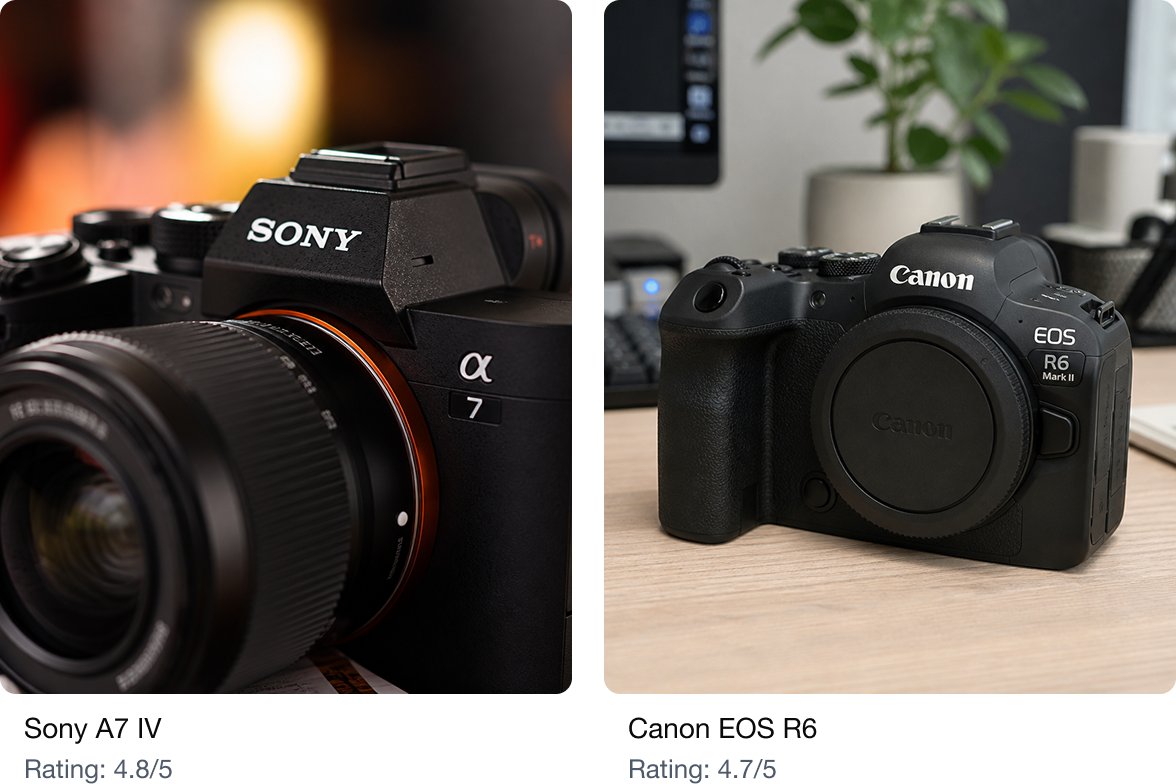
The mirrorless camera market has matured significantly over the past few years, with manufacturers continuously pushing the boundaries of image quality, autofocus intelligence, and video production capabilities. Among the most competitive options available today are the Sony A7 IV and Canon EOS R6 Mark II.
Sony α7 IV Mirrorless Camera Kit (ILCE-7M4K/B) with 28–70mm OSS Lens $2,339
Canon EOS R6 Mark II Mirrorless Camera RF24-105mm F4-7.1 $2,299
Both cameras occupy a similar price range and target advanced enthusiasts, professional photographers, content creators, wedding shooters, and videographers. However, despite their similarities, these cameras have distinct strengths that may make one a better choice depending on your shooting style.
Sony's A7 IV is often regarded as one of the most versatile hybrid cameras ever produced. It combines high-resolution photography with professional-grade video tools and a vast lens ecosystem.
Canon's EOS R6 Mark II, on the other hand, builds upon the success of the original R6 by improving speed, autofocus, and video performance while maintaining Canon's renowned color science and ergonomic design.
This review compares every major aspect of these cameras to help you determine which model deserves a place in your camera bag.
Specifications Overview
| Feature | Sony A7 IV | Canon EOS R6 Mark II |
|---|---|---|
| Sensor | 33MP Full-Frame BSI CMOS | 24.2MP Full-Frame CMOS |
| Image Processor | BIONZ XR | DIGIC X |
| Continuous Shooting | 10 fps | 12 fps Mechanical / 40 fps Electronic |
| Autofocus Points | 759 Phase Detection Points | 1053 AF Zones |
| Video Recording | 4K 60p 10-bit | 4K 60p Oversampled 10-bit |
| Viewfinder | 3.69M-dot OLED EVF | 3.69M-dot OLED EVF |
| LCD Screen | 3.0" Vari-Angle Touchscreen | 3.0" Vari-Angle Touchscreen |
| Image Stabilization | 5.5 Stops IBIS | Up to 8 Stops IBIS |
| Battery Life (CIPA) | Approx. 580 Shots | Approx. 450 Shots |
| Memory Card Slots | Dual SD/CFexpress Type A | Dual UHS-II SD |
| Weight | 658g | 670g |
| Launch Price | $2,339 | $2,299 |
Design and Ergonomics
Sony A7 IV
Sony significantly improved the ergonomics of the A7 IV compared to previous generations. The grip is deeper, buttons are larger, and the redesigned menu system is far more user-friendly than older Sony cameras.
Advantages
- Compact body size
- Excellent customization options
- Improved menu layout
- Professional control scheme
- Robust weather sealing
The camera feels modern and highly configurable, allowing photographers to tailor nearly every button and dial to their preferences.
Drawbacks
- Smaller grip than Canon
- Menu system still has a learning curve
- Controls can feel crowded for larger hands
Canon EOS R6 Mark II
Canon continues its reputation for excellent ergonomics with the R6 Mark II.
The camera feels exceptionally comfortable during long shooting sessions thanks to its deep grip and intuitive button placement.
Advantages
- Comfortable grip
- Logical button layout
- Beginner-friendly interface
- Excellent touchscreen responsiveness
- Familiar Canon handling
For photographers transitioning from DSLRs, the Canon often feels immediately comfortable.
Drawbacks
- Slightly bulkier body
- Fewer customization options than Sony
Winner: Canon EOS R6 Mark II
While both cameras are comfortable to use, Canon's ergonomics remain among the best in the industry.
Sensor Performance and Image Quality
Image quality remains one of the most important considerations when purchasing a professional camera.
Sony A7 IV
The Sony A7 IV features a 33-megapixel backside-illuminated full-frame sensor.
This higher resolution provides:
- Greater detail
- Better cropping flexibility
- Larger print capabilities
- Enhanced landscape photography performance
Photographers who frequently crop images or produce commercial work benefit significantly from the additional megapixels.
Strengths
- Outstanding dynamic range
- Excellent shadow recovery
- High detail retention
- Flexible RAW files
Canon EOS R6 Mark II
Canon uses a 24.2MP sensor, which may seem lower on paper but still delivers exceptional image quality.
Strengths
- Excellent color reproduction
- Beautiful skin tones
- Strong low-light performance
- Smaller file sizes for workflow efficiency
Many portrait and wedding photographers appreciate Canon's natural color rendering directly out of camera.
Dynamic Range Comparison
| ISO | Sony A7 IV | Canon R6 Mark II |
|---|---|---|
| 100 | Excellent | Very Good |
| 400 | Excellent | Very Good |
| 1600 | Excellent | Excellent |
| 6400 | Very Good | Excellent |
| 12800 | Good | Very Good |
Winner: Sony A7 IV
The higher-resolution sensor and superior dynamic range give Sony a slight edge for photographers who prioritize image quality and editing flexibility.
Autofocus Performance
Modern autofocus systems have become incredibly sophisticated, and both cameras rank among the best available.
Sony A7 IV Autofocus
Sony's Real-Time Tracking system uses AI-assisted subject recognition.
Supported Subjects
- Humans
- Animals
- Birds
- Vehicles
- Insects
Performance
The A7 IV tracks moving subjects with remarkable consistency, making it ideal for wildlife, sports, and event photography.
Canon EOS R6 Mark II Autofocus
Canon's Dual Pixel CMOS AF II system is equally impressive.
Supported Subjects
- Humans
- Animals
- Birds
- Horses
- Vehicles
- Aircraft
Performance
Canon's autofocus often feels slightly more natural and responsive in real-world shooting situations.
The subject acquisition speed is among the fastest available in any mirrorless camera.
Winner: Canon EOS R6 Mark II
While both systems are outstanding, Canon's autofocus performance is arguably the benchmark for sports and action photography.
Video Performance
Video capability has become a deciding factor for many buyers.
Sony A7 IV
Sony designed the A7 IV as a true hybrid camera.
Video Features
- 4K 60fps recording
- 10-bit 4:2:2 internal recording
- S-Cinetone profile
- S-Log3 support
- Full-size HDMI port
- Extensive codec options
Ideal For
- YouTube creators
- Documentary filmmakers
- Commercial video production
- Hybrid shooters
Canon EOS R6 Mark II
Canon dramatically improved the R6 Mark II's video capabilities.
Video Features
- Oversampled 4K 60fps
- Unlimited recording times
- Canon Log 3
- HDR PQ recording
- Excellent rolling shutter control
Ideal For
- Wedding videographers
- Content creators
- Event coverage
- Corporate video production
Video Comparison Table
| Feature | Sony A7 IV | Canon R6 Mark II |
|---|---|---|
| 4K 60p | Yes | Yes |
| 10-bit Internal | Yes | Yes |
| Log Profiles | S-Log3 | C-Log3 |
| Full HDMI | Yes | No |
| Rolling Shutter | Moderate | Better |
| Heat Management | Excellent | Excellent |
Winner: Sony A7 IV
Sony's professional video ecosystem and advanced codec options make it more attractive for serious videographers.
Low-Light Performance
Both cameras perform exceptionally well in dark environments.
Sony A7 IV
The higher-resolution sensor retains excellent detail in low-light scenes.
However, the smaller pixel pitch can result in slightly more visible noise at extremely high ISO settings.
Canon EOS R6 Mark II
The lower-resolution sensor allows larger individual pixels, which helps maintain cleaner images in challenging lighting conditions.
Winner: Canon EOS R6 Mark II
Wedding and event photographers frequently prefer Canon's cleaner high-ISO output.
Lens Ecosystem
One of Sony's biggest advantages is its mature E-mount lens lineup.
Sony E-Mount Advantages
| Manufacturer | Available Options |
|---|---|
| Sony | Extensive |
| Sigma | Extensive |
| Tamron | Extensive |
| Samyang | Extensive |
| Zeiss | Extensive |
The abundance of third-party lenses gives buyers more flexibility at different price points.
Canon RF Mount
Canon RF lenses are outstanding in quality but generally more expensive.
Advantages
- Exceptional optical performance
- Excellent stabilization
- Premium construction
Disadvantages
- Limited third-party autofocus options
- Higher lens costs
Winner: Sony A7 IV
Sony's ecosystem remains the most versatile full-frame mirrorless lens platform.
Battery Life
| Usage Scenario | Sony A7 IV | Canon R6 Mark II |
|---|---|---|
| Photography | Excellent | Very Good |
| Video | Excellent | Very Good |
| Travel | Excellent | Good |
| All-Day Events | Excellent | Very Good |
Sony delivers longer battery life in most situations.
Winner: Sony A7 IV
Who Should Buy the Sony A7 IV?
The Sony A7 IV is ideal for:
- Hybrid creators
- Commercial photographers
- Landscape photographers
- Content creators
- YouTubers
- Travel photographers
If you want maximum flexibility and future-proof features, the Sony A7 IV is one of the strongest options available.
Who Should Buy the Canon EOS R6 Mark II?
The Canon EOS R6 Mark II is ideal for:
- Wedding photographers
- Sports photographers
- Event shooters
- Portrait photographers
- Creators who prioritize ease of use
If autofocus reliability and user experience are your top priorities, Canon is extremely difficult to beat.
Final Verdict
Both the Sony A7 IV and Canon EOS R6 Mark II represent the pinnacle of modern hybrid mirrorless camera design. Neither choice is wrong, but each excels in different areas.
| Category | Winner |
|---|---|
| Resolution | Sony A7 IV |
| Dynamic Range | Sony A7 IV |
| Lens Ecosystem | Sony A7 IV |
| Battery Life | Sony A7 IV |
| Video Features | Sony A7 IV |
| Ergonomics | Canon R6 Mark II |
| Autofocus | Canon R6 Mark II |
| Sports Photography | Canon R6 Mark II |
| Low-Light Performance | Canon R6 Mark II |
Overall Winner for Hybrid Creators: Sony A7 IV ⭐
Overall Winner for Photographers & Action Shooters: Canon EOS R6 Mark II ⭐
If your work involves an equal mix of photography and professional video production, the Sony A7 IV offers the more versatile package. However, if your focus is weddings, sports, portraits, and fast-paced photography, the Canon EOS R6 Mark II remains one of the most satisfying cameras available in 2026.