

No-Touch Thermometer for Adults and Kids: Hygienic, Fast, and Family-Friendly Temperature Checks
Product Context
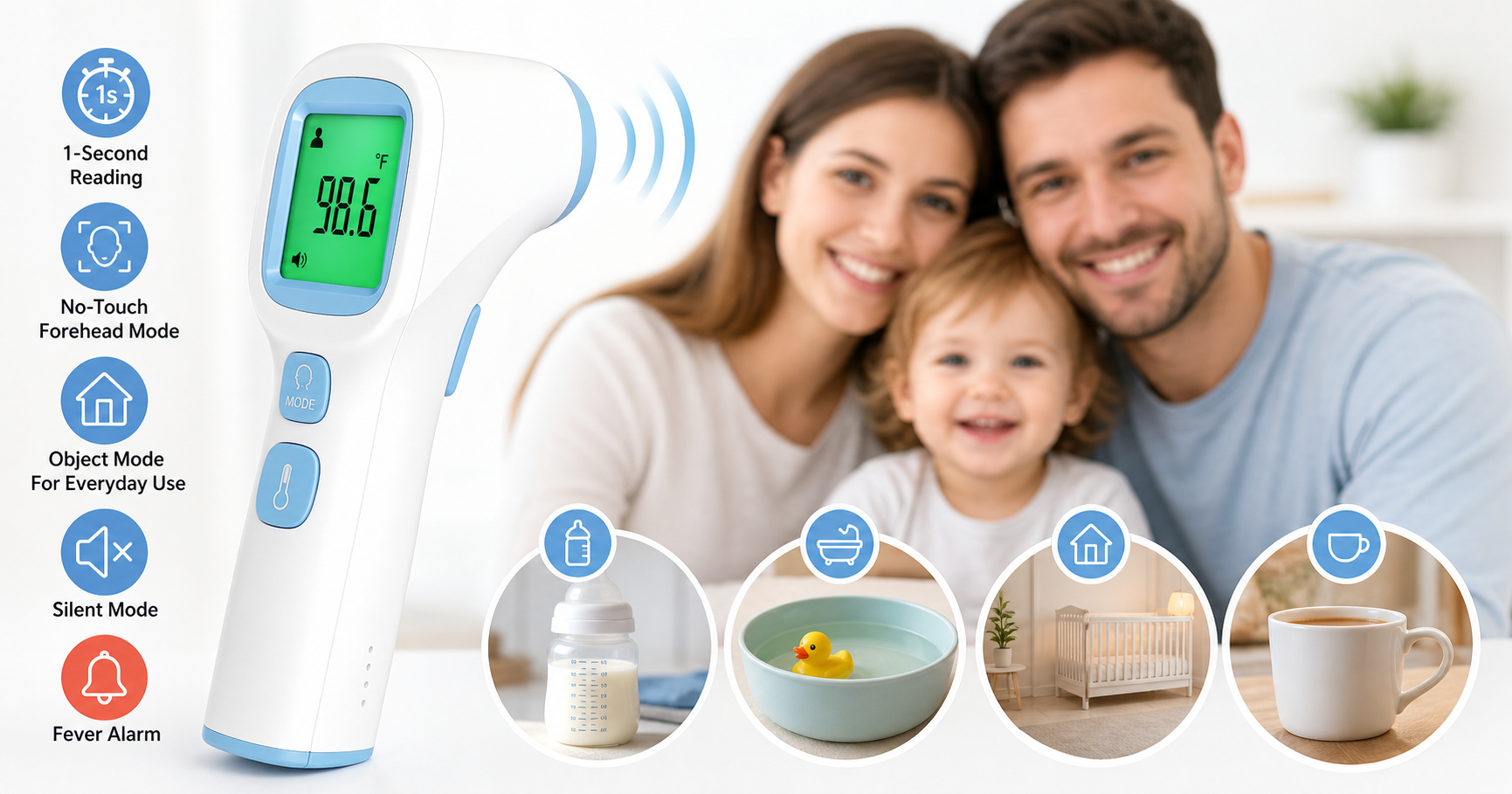
The No-Touch Thermometer for Adults and Kids, Accurate Digital Baby Thermometer, Fever Alarm & Silent Mode, 2 in 1 Forehead & Object Mode is a non-contact infrared thermometer aimed at families who want quick, hygienic temperature checks without disturbing a sleeping child. Sold primarily as a household health tool, it’s designed to work across age groups—from infants to adults—and to double as a simple surface thermometer for objects and liquids.
Positioned among other consumer-grade infrared thermometers, this model focuses on:
- Contactless operation to reduce cross-contamination
- Fast, one-button readings to simplify checks during illness
- Visual and/or audible fever alerts for quick interpretation
- Dual-use modes (forehead and object) to increase versatility around the home
It typically sits in the same general price band as other at-home forehead thermometers, often around $16.98 depending on promotions and availability.
Feature Breakdown
1. No-Touch Infrared Measurement
This thermometer uses an infrared sensor to read temperature from the forehead without physical contact. In practice, that usually means holding the device a short distance from the center of the forehead and pressing a single button for a reading.
Key aspects:
- Non-contact: Helps avoid waking a sick child and limits the spread of germs between family members.
- Infrared technology: Reads emitted infrared energy from the skin, converting it into a temperature value.
- Quick measurement: Most readings complete in about a second, which is helpful with fidgety toddlers.
2. 2-in-1 Forehead & Object Mode
A standout feature is the 2-in-1 functionality:
- Forehead Mode: Intended for body temperature readings on adults, kids, and babies.
- Object Mode: Measures the temperature of non-living surfaces—such as milk in a bottle, bathwater, or room surfaces.
This versatility is particularly useful for parents who regularly need to confirm that:
- A baby’s bottle isn’t too hot
- Bathwater is in a comfortable range
- A room or nursery is not overly warm or cold
3. Fever Alarm
The thermometer integrates a fever alarm, which typically works by:
- Threshold-based alert: When a reading crosses a preset temperature threshold, the thermometer signals a potential fever.
- Sound and/or color cues: Many devices use beeps and a screen color change (for example, green for normal, orange for mild elevation, red for high fever). This product description emphasizes an alarm function, so you can expect some sort of clear indication when readings are above normal.
This is especially helpful for caregivers who want quick, at-a-glance feedback without interpreting exact values every time.
4. Silent Mode
The silent mode is designed for nighttime and nap-time checks:
- Disables or softens audible beeps when taking a reading.
- Allows temperature checks on sleeping children without loud alerts.
In practical terms, being able to switch to silent mode can significantly reduce the chance of waking a child when you’re just trying to verify that their fever is going up or down.
5. Digital Display & Controls
While exact display details vary by batch, this type of thermometer commonly includes:
- Backlit digital display for visibility in dim rooms
- Simple, one-button operation to take a reading
- Mode toggle (forehead vs. object) via a dedicated button or by cycling through options
- Battery indicator so you know when to replace the cells
The product aims to remain intuitive enough that multiple caregivers (parents, grandparents, babysitters) can use it confidently with minimal instruction.
Performance Insights
Accuracy & Consistency
As with most consumer infrared forehead thermometers, performance is best understood in terms of trends and consistency rather than as a perfect replacement for clinical-grade measurements.
Strengths:
- Fast readings reduce the time a sensor has to be affected by movement.
- Non-contact design eliminates errors caused by improper probe placement under the tongue or in the ear.
- Reasonably consistent when used under stable conditions (indoors, no sweat on the forehead, no direct drafts).
Common limitations you should expect from this category of device:
- Environmental sensitivity: Very hot or cold room temperatures, or sweat on the forehead, can skew readings.
- Surface-level measurement: Forehead devices measure skin temperature, which can differ from core body temperature. This is why many health professionals recommend confirming concerning results with an oral, rectal, or ear thermometer.
For day-to-day home use, this thermometer is best treated as a screening and monitoring tool:
- Use it to see whether someone may have a fever.
- Track whether a fever is trending up or down over time.
- Confirm extreme or borderline values with a more traditional contact thermometer if needed.
Speed & Responsiveness
The device is marketed around instant or near-instant readings (around one second):
- Helpful with restless children or adults who feel unwell and don’t want to hold a device in place for long.
- Makes it feasible to take multiple readings in short succession if you want to confirm a result.
Reliability Over Time
Infrared thermometers typically maintain performance as long as:
- Batteries are fresh
- The lens area is kept clean and free of dust or fingerprints
- The device is stored at room temperature and allowed to acclimate if moved from a very hot or cold environment
Careful handling and periodic cleaning of the sensor window with a soft, dry cloth can help preserve measurement reliability.
Usability
Setup and Everyday Use
Most buyers will find setup straightforward:
- Insert the included batteries (or replace with standard cells when needed).
- Power on the thermometer.
- Select forehead or object mode.
- Hold the device at the recommended distance from the forehead or object.
- Press the main measurement button and wait for the reading.
The user experience is tailored to busy households:
- Single-handed operation allows you to hold a child with one hand and operate the thermometer with the other.
- Clear, digital readout is easy to interpret at a glance.
- Silent mode configuration is generally done with a long press or a settings combination, and remains set until changed back.
Comfort and Safety
The no-touch design offers several ergonomic benefits:
- No physical contact reduces discomfort or anxiety, especially in young children.
- No disposable probe covers are needed, which simplifies routine use and cuts ongoing consumable costs.
- Lower cross-contamination risk compared to shared oral or rectal thermometers.
Suitability for Different Users
- Babies and toddlers: Very convenient for quick checks during naps or nighttime, with silent mode to avoid waking them.
- Older kids: Non-threatening design helps reduce resistance compared to rectal or oral thermometers.
- Adults: Fast, simple readings when feeling unwell, suitable for self-checks.
- Caregivers and grandparents: Straightforward interface and large display are typically easy to learn and read.
Trade-offs
While the thermometer is feature-rich for a home device, there are some trade-offs to be aware of:
Pros
- Hygienic, no-contact measurement suitable for multi-person households
- Fast, one-button readings that work well with children and during nighttime checks
- 2-in-1 forehead and object mode adds real-world versatility (bottle, bath, room checks)
- Fever alarm and optional silent mode support both quick interpretation and quiet operation
- No need for disposable probe covers, reducing ongoing costs and waste
Cons
- Less precise than clinical methods such as rectal or well-calibrated oral thermometers, especially for infants when exact core temperature is critical
- Sensitive to technique and environment—distance, angle, sweat, and ambient temperature can all affect readings
- Not a substitute for medical assessment: persistent high readings or concerning symptoms should still prompt consultation with a healthcare professional
- May require confirmation: borderline or unexpectedly low/high readings are best double-checked with a secondary thermometer type if accuracy is in doubt
Compared with basic digital oral thermometers, this device trades a small amount of absolute accuracy for speed, convenience, and comfort, which many families find worthwhile for everyday monitoring.
Conclusion
The No-Touch Thermometer for Adults and Kids, Accurate Digital Baby Thermometer, Fever Alarm & Silent Mode, 2 in 1 Forehead & Object Mode is a practical, family-focused option for households that prioritize quick, hygienic temperature checks. Its non-contact operation, dual-use modes, built-in fever alert, and quiet operation make it especially appealing for parents managing nighttime fevers or caring for multiple children.
If you need hospital-grade precision for high-risk medical situations, you should still keep a more traditional contact thermometer on hand and follow your healthcare provider’s guidance. For routine home monitoring, however, this no-touch thermometer offers a strong balance of ease of use, comfort, and versatile everyday functionality at around $16.98, making it a reasonable addition to most home health kits.