

Gotrax KS1 Kids Kick Scooter Review: A Stable, Light-Up Starter Scooter for Ages 2–8
Introduction
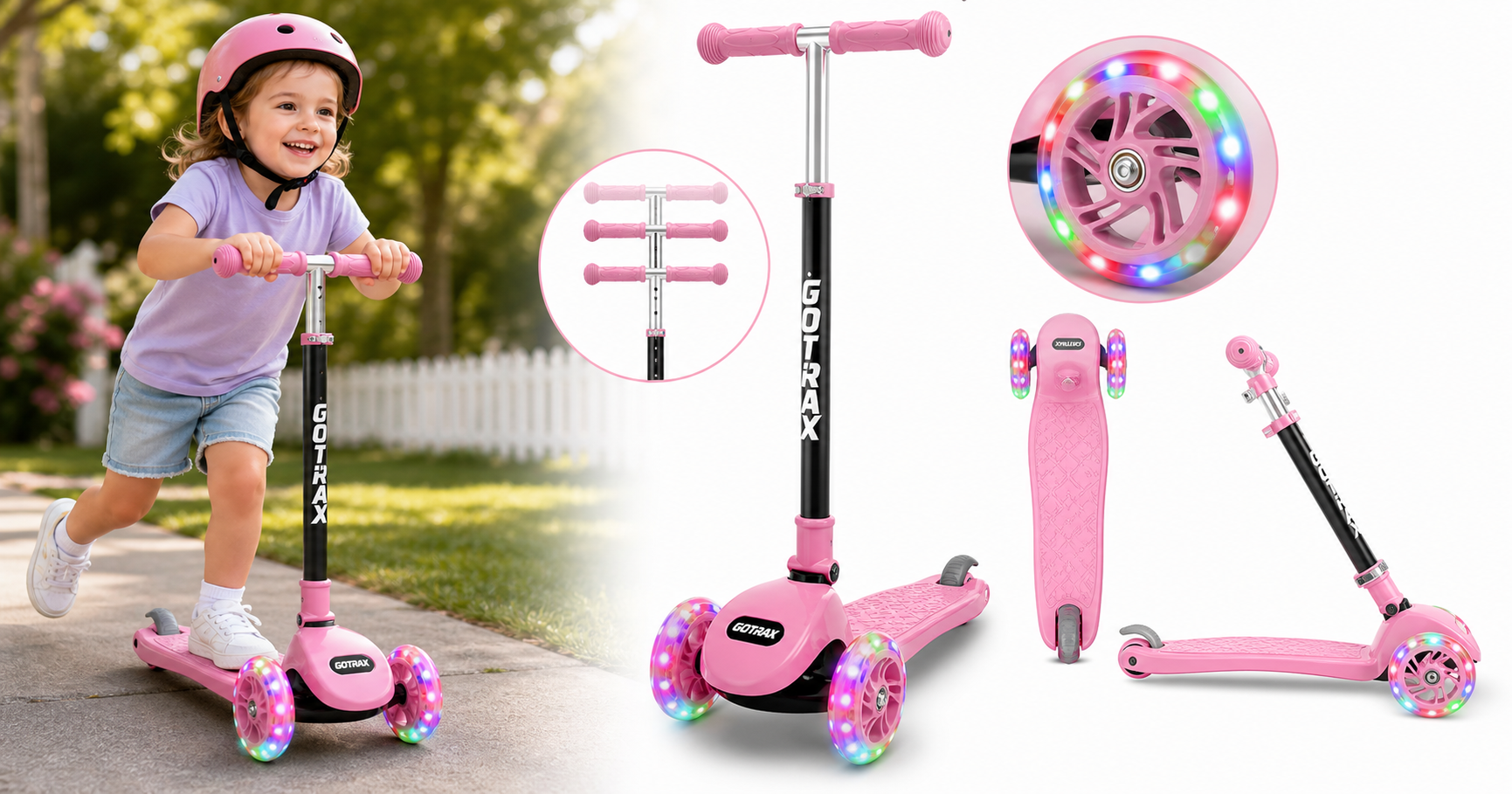
The Gotrax KS1 Kids Kick Scooter is a three‑wheel kick scooter aimed at young riders who are just learning to balance and steer. With LED‑lighted wheels, a wide anti‑slip deck, lean‑to‑steer control, and three adjustable handlebar heights, it is positioned as an accessible first scooter for children aged approximately 2–8 years and up to 110 lbs.
Available in multiple bright colors and sold through retailers like Amazon at around $37.99, the KS1 competes with other entry‑level three‑wheel scooters for toddlers and early elementary‑age kids. This review looks at how it performs in typical family scenarios, where it works best, and where parents may want to be cautious.
Typical Use Cases
1. First Scooter for Toddlers (Ages ~2–4)
For younger children, the KS1 is often used as a first real scooter once they’ve outgrown ride‑on toys. The three‑wheel design (two up front, one in the rear) offers added stability while the lean‑to‑steer mechanism helps them begin to develop balance and coordination rather than relying only on handlebar turning.
Typical activities include:
- Short rides on the sidewalk in front of the house
- Supervised play in the driveway or cul‑de‑sac
- Quick trips to a nearby playground or park
2. Daily Neighborhood and Park Rides (Ages ~4–7)
As children grow, the three adjustable handlebar heights allow the scooter to be raised to better match their size. At this stage, kids are more confident and tend to ride:
- On neighborhood sidewalks
- Around playground paths
- Alongside parents walking or pushing a stroller
The LED wheels become more of a fun factor here, especially at dusk, encouraging kids to keep using the scooter as they get older.
3. Occasional School Runs and Family Outings
For some families, the KS1 doubles as a short‑distance transport option—for example:
- Scooting a few blocks to preschool or early elementary school (where sidewalks are smooth and continuous)
- Using it on family walks or outings where the child rides intermittently and a parent occasionally carries or pushes the scooter
Because of its relatively low weight and simple folding/detachable stem (depending on the specific batch and packaging), it can be stowed in a car trunk without taking much space.
Performance in Each Scenario
First Scooter for Toddlers
Stability and balance:
- The three‑wheel setup and wide deck give toddlers a solid, confidence‑inspiring platform.
- Lean‑to‑steer means the scooter responds to body movement rather than sharp handlebar turns, which generally reduces the chance of sudden, jerky steering that can cause falls.
Learning curve:
- Most young riders adapt quickly to the lean‑to‑steer system after some supervised practice.
- The rear fender brake is easy for small feet to reach, though parents often still act as the primary “brake” at this stage by walking close behind.
Ride comfort:
- The small solid wheels are fine for smooth pavement and indoor or garage floors.
- Cracks, gravel, and uneven sidewalk joints can be jarring; this is typical for scooters in this class and is a reason to limit use to smoother surfaces with young toddlers.
Neighborhood and Park Rides
Handling and maneuverability:
- For kids who already have basic scooter experience, the KS1 turns predictably and feels intuitive.
- The lean‑to‑steer geometry favors sweeping turns rather than ultra‑tight cornering. It’s well‑suited to paths and sidewalks but not ideal for trick riding or sharp obstacle courses.
Speed control:
- As a non‑electric kick scooter, speed is entirely rider‑controlled. This makes it easier for parents to set expectations and limits.
- The rear fender brake remains adequate for the moderate speeds typical of young riders, though it still relies on the child’s judgment and coordination.
Durability in everyday use:
- For light to moderate neighborhood use, the frame and deck are generally sturdy enough for children within the specified weight limit.
- With regular use on rougher pavement, some families report that lower‑cost kids’ scooters in general can develop rattles, worn wheels, or loosened hardware over time. The KS1 is no exception—it’s best treated as a light‑duty, beginner scooter rather than a long‑term heavy‑abuse toy.
School Runs and Family Outings
Portability:
- The scooter’s low overall weight makes it easier for adults to carry when kids get tired.
- Depending on the production run and how it’s assembled, the stem can typically be detached for storage, but it is not a premium one‑click folding system like higher‑end commuter scooters. Parents should expect basic packability, not advanced folding hardware.
Practicality for commuting‑style use:
- For short, smooth trips it performs adequately.
- For longer routes or rougher sidewalks, children may fatigue more quickly because of the vibration from small solid wheels and the effort required to push compared with larger‑wheeled or suspension‑equipped scooters.
Strengths Across Scenarios
1. Beginner‑Friendly Stability
The three‑wheel platform and wide anti‑slip deck are the KS1’s core advantages. They give children more lateral stability than two‑wheel scooters, making it a solid option for kids who are still working on balance and coordination.
2. Adjustable Handlebar Heights
Three handlebar height settings allow the scooter to grow with the child for several years. This flexibility helps extend its usable life, particularly if you begin using it when the child is around preschool age rather than at the top of the stated age range.
3. Lean‑to‑Steer Learning Experience
Lean‑to‑steer encourages children to control the scooter with their body weight rather than relying solely on turning the handlebars. This can:
- Promote better balance and coordination
- Make transitions to two‑wheel scooters or bikes smoother later on
4. LED‑Lighted Wheels
The LED wheels serve both fun and functional purposes:
- They add visual appeal that kids tend to love, which can encourage frequent use.
- They increase visibility in low‑light conditions, which can be a modest safety benefit when riding near dusk (though they’re not a replacement for proper visibility gear or lighting where required).
5. Lightweight and Simple
The scooter’s lightweight build and simple mechanical design:
- Make it easier for young kids to propel and maneuver
- Allow parents to carry it without much strain
- Reduce the maintenance complexity versus electric models or more intricate folding mechanisms
Limitations Across Scenarios
1. Long‑Term Durability Concerns
While many families find the KS1 adequate for beginner use, several factors suggest it’s best viewed as an entry‑level rather than a long‑term heirloom scooter:
- Lower‑cost plastics and hardware can show wear if the scooter is used heavily, stored outdoors, or frequently ridden on rough surfaces.
- As with many budget‑friendly brands, user feedback around the broader Gotrax line is mixed on long‑term reliability and after‑sales responsiveness. Parents who expect a scooter to last for many siblings over many years may want to temper expectations.
2. Limited Comfort on Rough Surfaces
The small solid wheels transmit bumps and cracks directly to the deck. On:
- Rough asphalt
- Broken sidewalks
- Gravelly sections
the ride can feel harsh and less secure, particularly for lighter toddlers. This is common in this category, but it does mean you’ll get the best experience on smooth concrete and indoor surfaces.
3. Basic Hardware and Adjustments
Compared with premium kids’ scooters:
- The adjustability mechanisms and clamping hardware are more utilitarian than refined.
- Parents must ensure that the handlebar height adjustment is fully engaged and clamped (including any metal peg or detent) before riding; incomplete engagement can lead to instability.
4. Outgrown by Confident Older Riders
Although the stated age range extends up to about 8 years and a weight limit around 110 lbs, many confident riders in the upper half of that range may start to crave:
- A faster, more responsive two‑wheel scooter
- Larger wheels for smoother rolling
- More advanced features (e.g., trick‑capable decks, suspension, or upgraded bearings)
For those children, the KS1 may feel limiting after they gain skills, even if they remain within the listed height and weight specifications.
5. No Advanced Safety Features
The KS1 is a straightforward manual scooter without:
- Integrated lights beyond the wheel LEDs
- Reflectors on the frame (depending on region and batch)
- A steering lock or speed‑governing mechanism
Parents remain responsible for providing safety gear (helmet, and where appropriate, pads) and setting clear riding boundaries.
Verdict
The Gotrax KS1 Kids Kick Scooter is a practical, beginner‑friendly three‑wheel scooter that aims squarely at young children who are just starting to explore scooting. Its main strengths are:
- Stable three‑wheel design and wide, anti‑slip deck
- Lean‑to‑steer handling that helps develop balance
- Three adjustable handlebar heights to grow with the child
- Lightweight build and eye‑catching LED wheels at an accessible price point around $37.99
On the other hand, parents should be aware that:
- Ride comfort is best on smooth surfaces; rougher terrain can feel harsh.
- Long‑term durability and refinement are in line with its entry‑level positioning rather than premium competitors.
- Confident older kids may outgrow its capabilities before they outgrow the stated weight limit.
If your priority is an affordable, stable first scooter to introduce toddlers and young children to scooting on sidewalks and smooth paths, the Gotrax KS1 is a reasonable option. Families seeking a more robust, longer‑term scooter with higher‑end materials, larger wheels, or more advanced features may want to consider stepping up to a premium three‑wheel model or a two‑wheel scooter once the child’s balance and confidence have developed.
For more details or up‑to‑date specifications, consult the product listing: https://www.amazon.com/dp/B0CCYMV1T1