

3M Ultra Headlight Restoration Kit (39195) Review: A Heavy‑Duty Fix for Cloudy Plastic Lenses
Introduction
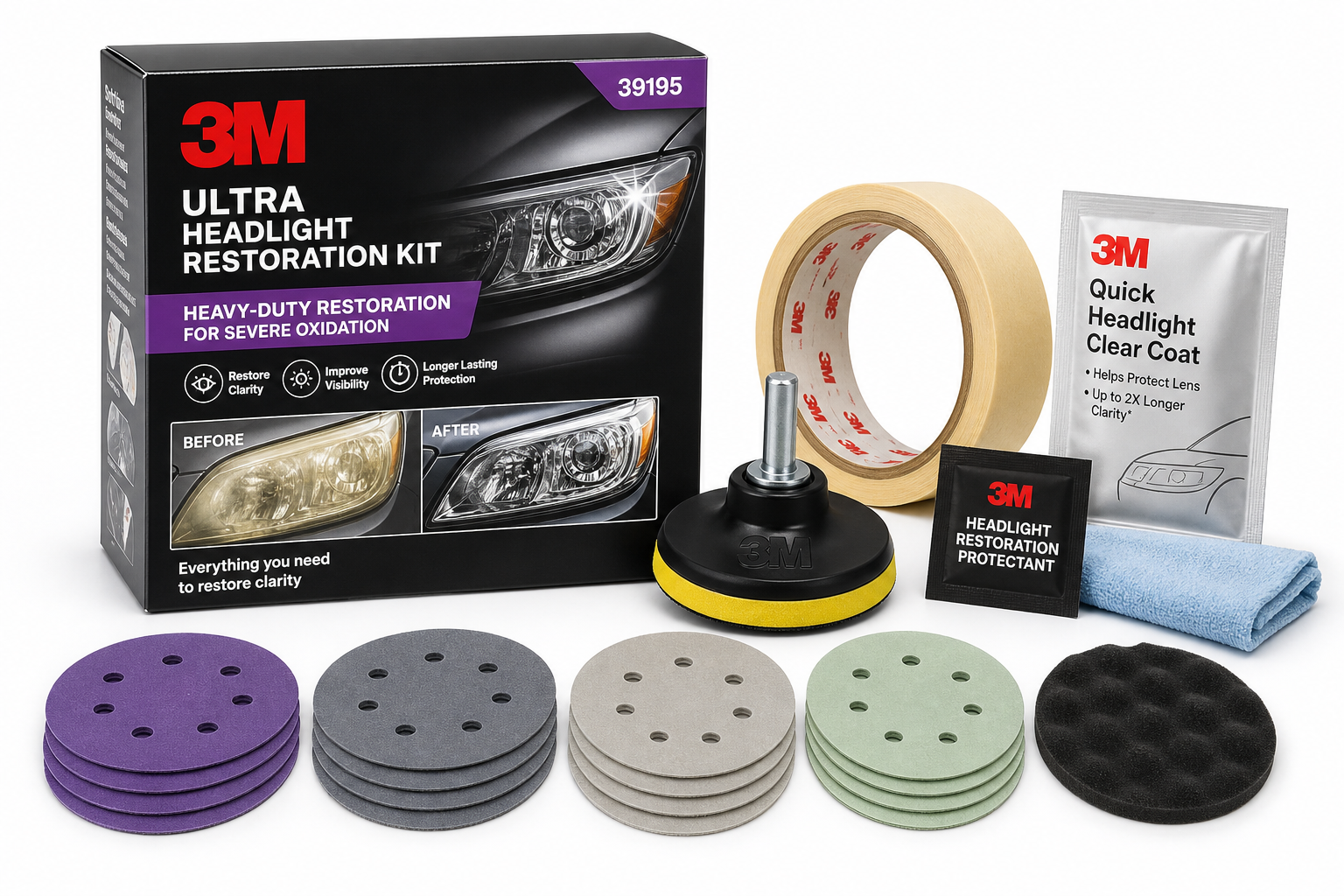
The 3M Ultra Headlight Restoration Kit (model 39195) is a professional‑grade, DIY solution aimed at restoring clarity to cloudy, yellowed, or lightly scratched plastic lenses. Designed for use with a common household drill, it combines 3M’s abrasive technology with masking tape, multiple sanding and finishing discs, and a protectant to tackle more severe oxidation than wipe‑on or single‑step kits typically can.
Rather than replacing faded headlight assemblies outright, this kit focuses on resurfacing and refinishing the outer layer of the plastic, then sealing it to slow future degradation. For owners of older vehicles with heavily weathered headlights, that can translate into meaningful visibility improvements and potential cost savings compared to new lenses. On retailers like Amazon, the kit is frequently positioned as a higher‑intensity option within 3M’s headlight restoration lineup and is often available around $14.49, making it accessible for most DIY users who already have a drill.
Typical Use Cases
1. Restoring Older Daily Drivers
One of the most common scenarios for the 3M Ultra Headlight Restoration Kit is an older commuter car whose headlights have turned yellow or cloudy after years in the sun. These lenses often show:
- General hazing and yellowing across the entire lens
- Fine surface scratches from road debris and previous cleanings
- Noticeable reduction in nighttime light output
In this context, the kit is used to restore safe levels of brightness while improving cosmetic appearance enough that the vehicle looks less dated and better maintained.
2. Refreshing Enthusiast or Weekend Cars
Enthusiasts with older coupes, sedans, or SUVs often want a more refined finish and are willing to spend extra time on technique. For them, the kit is suited to:
- Carefully removing oxidation around complex lens shapes
- Improving the appearance of vehicles being prepared for sale or meets
- Pairing with general detailing work (paint correction, polishing, etc.)
Because it uses a multi‑step sanding process and clear coat, it offers more control over the final clarity than simpler wipe‑only solutions.
3. Light Professional or Side‑Gig Use
Detailers and hobbyists who occasionally restore headlights for others can leverage the 39195 kit as a small, repeatable system. While it’s packaged for consumer use, its multi‑grit sanding discs and clear‑coat approach align with basic professional methods.
Use cases here include:
- Add‑on services for friends, family, or local customers
- Restoring headlights on used cars being prepared for resale
- Occasional work on motorcycles, trailers, or SUVs with plastic lenses
4. Non‑Headlight Plastic Lenses
Although the product is marketed primarily for headlights, it is designed for use on a range of clear plastic automotive lenses:
- Taillights
- Fog lights
- Directional/indicator lights
- Similar clear plastic pieces where clarity matters
On these smaller or less critical surfaces, the kit can significantly improve uniformity and overall vehicle appearance.
Performance in Each Scenario
Performance on Heavily Oxidized Daily Drivers
For lenses with pronounced yellowing and surface roughness, the multi‑stage abrasive system is the core of the kit’s performance:
- Initial sanding discs: The coarser discs remove the outermost, heavily oxidized layer. This step usually turns the lens uniformly cloudy, which is expected.
- Intermediate finishing discs: The medium‑grit discs further refine the surface, reducing the depth and number of visible sanding marks.
- Fine Trizact disc: The ultra‑fine disc smooths the surface to the point where it is ready for sealing, restoring optical clarity when combined with the final protectant.
On older daily drivers, the result is typically a dramatic visual improvement, with significantly clearer lenses and restored light output. However, success is very technique‑dependent: even pressure, consistent movement, and patience are essential to avoid uneven results.
Performance on Enthusiast and Weekend Vehicles
When the user is willing to be meticulous, this kit can yield near‑factory clarity, especially on lenses that are structurally intact but cosmetically degraded. Enthusiast users often:
- Spend extra time on masking to protect surrounding paint and trim
- Use more deliberate, overlapping passes with each grit
- Inspect lenses under strong lighting between steps to ensure uniform sanding
In this use case, the kit’s performance shines: the combination of controlled abrasion and clear coat can restore both sharpness and gloss. For owners who already perform their own detailing, the learning curve is relatively manageable and the end result can rival basic shop restorations.
Performance in Light Professional or Side‑Gig Work
For low‑volume professional use, the 3M Ultra Headlight Restoration Kit offers:
- Consistency: All required abrasives and protectants are standardized in the kit, leading to predictable, repeatable outcomes.
- Speed: With practice, restoring a pair of headlights can often be done in roughly an hour or slightly more, particularly when oxidation is moderate rather than extreme.
- Portability: Only a drill and the kit are required—no large polishing machines or extensive product inventories.
However, as usage volume increases, consumables (sanding discs and clear‑coat wipes or liquids) will be depleted more quickly, and it may become more economical to purchase bulk abrasives and sealants instead of full retail kits for each job.
Performance on Taillights, Fog Lights, and Small Lenses
On smaller lenses, the kit is generally easier to manage:
- Less total area to sand reduces time and effort
- Curved or intricate surfaces are still challenging, but the smaller footprint means it’s easier to control the drill and pad
- Visual improvement is often quite striking, as taillights and fog lights can accumulate a surprising amount of haze and micro‑scratches
Because these lenses usually contribute less to forward nighttime visibility than headlights, the primary benefit here is aesthetic and resale‑focused, though improved brightness and signaling can still be a practical plus.
Strengths Across Scenarios
-
Thorough, Multi‑Step Abrasive System
The main advantage of the 3M Ultra Headlight Restoration Kit is its structured, multi‑grit approach. Rather than trying to mask oxidation with fillers, it physically removes the damaged plastic layer and refines the surface step by step. This often yields more durable and consistent results than one‑step wipes or polishes. -
Designed Specifically for Plastic Automotive Lenses
All components—from the sanding discs to the protectant—are tailored for clear automotive plastics instead of generic household plastics. This specialization helps strike a balance between effective material removal and minimizing the risk of deep, permanent scratching when used correctly. -
Compatibility with Common Household Drills
By using a standard drill instead of requiring a dedicated polisher, the kit stays accessible to typical DIY users, while still providing enough power and speed to complete a proper, abrasion‑based restoration. -
Comprehensive Kit Contents
The inclusion of masking tape, disc pad holder, multiple grits of sanding discs, and final protectant means most users won’t need to purchase additional consumables for a single restoration job (aside from a spray bottle of water and clean microfiber towels). -
Potential Cost Savings vs. New Lenses
For vehicles where replacement headlight assemblies are expensive, the kit offers a way to defer or avoid that cost. Even a single effective restoration can offset the kit’s price, particularly when it is purchased for around $14.49. -
Noticeable Safety and Aesthetic Impact
Clearer headlights improve the spread and intensity of the beam pattern, aiding nighttime visibility. A side benefit is that vehicles simply look newer and better maintained, which can be important before selling or trading in.
Limitations Across Scenarios
-
Skill and Patience Required
This is not a quick wipe‑on solution. Achieving good results means:- Maintaining even pressure and motion with the drill
- Allowing enough time for each grit to fully do its job
- Carefully following the instructions and safety precautions
Inexperienced users may leave uneven patches, sanding marks, or minor distortions in the lens if they rush or skip steps.
-
Not a Fix for Internal Damage or Cracked Lenses
The kit targets exterior surface oxidation and fine scratches. It cannot address:- Moisture or condensation inside the headlight housing
- Internal reflector or projector damage
- Cracks, chips, or severe structural damage in the lens itself
In those cases, replacement assemblies may still be necessary.
-
Drill Access Is Mandatory
Unlike 3M’s simpler, hand‑applied restoration products, this specific kit relies on a powered drill. Users without a suitable drill—or those uncomfortable using power tools on their vehicle—may find it intimidating or impractical. -
Consumables Are Single‑Use or Limited‑Use
While many users can restore a pair of headlights with one kit, there is limited margin for multiple attempts or future touch‑ups, especially if the lenses are heavily oxidized and require more aggressive sanding. As a result, frequent restorers may prefer a more modular, refillable system. -
Results Still Require Ongoing Care
Even with a clear‑coat or protectant, restored headlights will gradually weather again over time. Periodic washing, use of UV‑protective sealants, and parking out of direct sun where possible can help extend the clarity, but permanent, maintenance‑free results should not be expected. -
Potential to Affect Beam Pattern if Misused
Over‑sanding localized areas or applying uneven pressure can subtly alter the surface geometry of the lens, which may, in turn, affect the beam pattern. This is largely avoidable with proper technique, but it is a risk for users who skip instructions or dwell too long in one spot.
Verdict
The 3M Ultra Headlight Restoration Kit (39195) is a capable, heavy‑duty solution for restoring plastic automotive lenses that have moved beyond what quick cleaners and polishes can handle. Its multi‑stage abrasive process and included protectant allow it to remove significant oxidation and surface damage, often yielding a dramatic improvement in clarity and appearance.
It is best suited for:
- Owners of older vehicles with noticeably yellowed or cloudy headlights
- Enthusiasts and DIYers comfortable using a drill and following multi‑step procedures
- Light professional or side‑gig users wanting a standardized, kit‑based approach for occasional restorations
It is less ideal for:
- Users without access to a drill or who prefer very quick, low‑effort solutions
- Lenses with internal issues, cracks, or severe structural damage where replacement is more appropriate
Considering its typical street price around $14.49, the 3M Ultra Headlight Restoration Kit offers solid value when used correctly, particularly given the potential savings versus new headlight assemblies. For those willing to invest an hour or two of careful work per vehicle, it can restore both the look and function of aging headlights to a level that feels disproportionately rewarding for the cost and effort involved.