

COMFEE' Portable Mini Dishwasher Countertop Review: Compact Cleaning for Small Spaces
Introduction
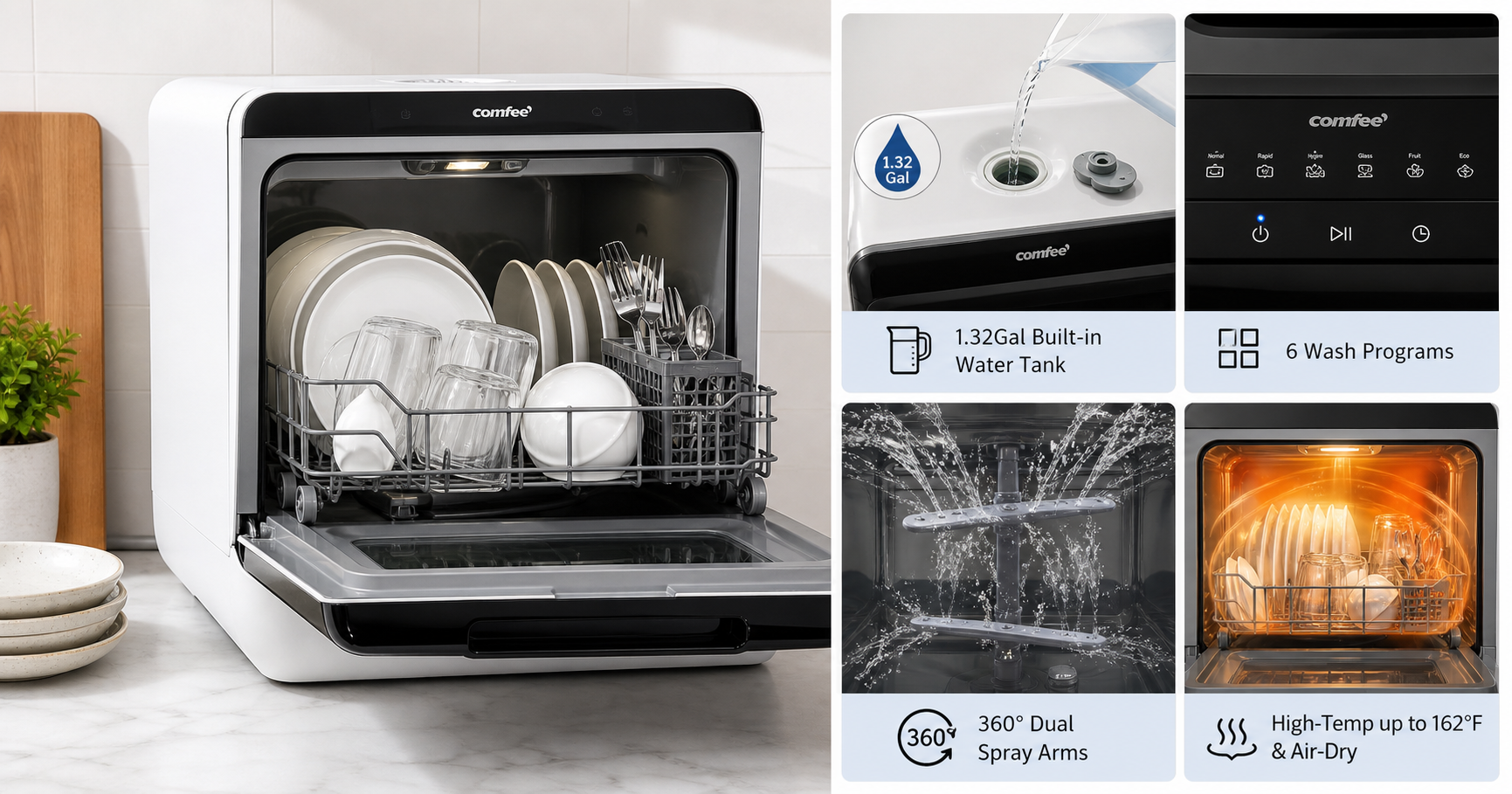
The COMFEE' Portable Mini Dishwasher Countertop with 1.32Gal Built-in Water Tank is built for people who want automatic dishwashing but lack the space or plumbing for a traditional built-in unit. Instead of requiring a fixed water hookup, it uses a 1.32-gallon internal tank that you fill manually, making it suitable for renters, RV owners, and anyone who needs a non-permanent solution.
Key characteristics include:
- Compact body (roughly 17" deep, 16.5" wide, 17" high), small enough for most countertops and RV kitchen areas.
- 1.32-gallon built-in water tank, so no faucet connection is required if you don’t want to use one.
- Six wash programs, typically including options such as Normal, Rapid, Hygiene/High-Temp, Glass/Delicate, Fruit, and possibly an Eco-style cycle.
- 360° dual spray arms to cover the full interior.
- High-temperature wash up to around 162°F combined with an air-dry function for improved sanitation and drier dishes.
On most major retailers the COMFEE' Portable Mini Dishwasher is positioned as a mid-range compact model, with pricing often around $249.99, making it competitive among tank-style countertop dishwashers.
Typical Use Cases
This unit is targeted at scenarios where space and plumbing are constrained but regular dishwashing is still needed.
1. Small Apartments and Studios
In studios and one-bedroom apartments without a built-in dishwasher, this model can sit on a countertop or a sturdy cart. It is best suited for:
- One- to two-person households.
- Daily or every-other-day loads of plates, bowls, cups, and cutlery.
- Light cookware such as small pots, pans, and food containers (within the interior height limits).
2. RVs, Camper Vans, and Tiny Homes
The integrated water tank makes it appealing for mobile or off-grid setups where a permanent faucet connection isn’t feasible. As long as you have:
- A stable, level surface.
- A nearby sink, drain, or grey water container for the drain hose.
- Access to a standard 120 V outlet.
…it can function as a semi-portable solution that can be moved or stored when traveling.
3. Dorm Rooms and Shared Housing
Where allowed by building rules, it can help students or shared households manage dishes without relying entirely on handwashing in small sinks. Its relatively small footprint and tank-based design reduce the need for landlords to approve plumbing changes.
4. Supplemental Dishwasher in Larger Homes
Some users may deploy it as a secondary machine for:
- Baby bottles, cutting boards, and utensils that need more frequent or high-temp cleaning.
- Small loads between full-size dishwasher cycles.
In this role, its quick and hygiene-focused cycles are often more important than pure capacity.
Performance in Each Scenario
Performance in Small Apartments
In a typical apartment setup, this unit can comfortably handle daily dishes for one or two people, provided you’re realistic about what fits.
Cleaning quality
- The 360° dual spray arms do a good job of reaching most surfaces when the rack is loaded thoughtfully (heavily soiled items facing the spray, minimal overlapping).
- The Normal and Hygiene/High-Temp programs deliver the most thorough results, especially on dried or greasy food.
- Quick or Rapid cycles can be adequate for lightly soiled dishes but are less reliable for baked-on residues.
Noise
- Sound levels are generally in the low 60 dB range, comparable to a conversation. This is noticeable in a small studio but usually not disruptive during daytime use.
Water and energy use
- Each cycle uses about 1.32 gallons of water, significantly less than typical handwashing for a similar number of items.
- For renters paying for utilities or with environmental concerns, this is a tangible benefit.
Performance in RVs and Tiny Homes
In mobile or tiny spaces, performance is strongly tied to how well you manage water and power.
- The built-in tank allows you to measure exactly how much water each cycle consumes. This gives better control in off-grid scenarios, especially when drawing from limited storage tanks.
- The high-temperature cycle is beneficial for sanitizing dishes when water supply lines may be less stable or when you’re using stored water.
- The main limitation is the current draw on your electrical system. It’s designed for standard 120 V household outlets, so you’ll need an appropriately rated inverter or shore power.
Performance in Dorms and Shared Spaces
The dishwasher can reduce conflicts over dirty dishes, but it requires some organization:
- Capacity is around two place settings, so multiple users will need to run more frequent cycles rather than waiting for a large shared load.
- Because there’s no permanent plumbing, it doesn’t alter the space in ways that dorms typically prohibit, but residents must be careful with drainage to avoid spills.
As a Supplemental Dishwasher
For households that already have a full-size unit, this model works best as a specialized cleaner:
- The Hygiene/High-Temp mode is useful for cutting boards, baby items, or any dishes that you want to wash separately.
- Its quick cycles can handle small loads without occupying the main dishwasher.
- However, its limited capacity and interior height mean it’s not well-suited for large cookware or baking sheets.
Strengths Across Scenarios
1. True No-Hookup Operation
The standout feature is the 1.32-gallon internal tank. You can:
- Fill it with the included pitcher or any container.
- Place the unit away from the sink, provided the drain hose can reach a drain or bucket.
- Avoid dealing with faucet adapters, which can be tricky with modern pull-down or specialty faucets.
For renters or RV owners, this flexibility is a major advantage over faucet-only countertop models.
2. Compact, Self-Contained Design
The footprint and height are small enough for many standard cabinets and shelves, and the overall weight is manageable for two people to lift. The door’s viewing window and internal light (on many variants) make it easy to visually confirm operation and loading.
3. Multiple Wash Programs
The six program options allow some tuning based on what you’re washing:
- Normal / Standard: Balanced for typical mixed loads.
- Hygiene / High-Temp: Higher temperatures for heavily soiled items and improved sanitation.
- Rapid / Quick: Shorter cycle time for lightly soiled dishes.
- Glass / Delicate: Gentler spray and shorter heat exposure for fragile glassware.
- Fruit / Rinse-only: Light rinse cycle that can double as a quick pre-rinse.
- Eco or similar: Where available, focuses on reduced energy and water.
This variety is more flexible than very basic mini units that offer only one or two modes.
4. High-Temperature Cleaning and Air-Dry
The 162°F high-temp capability combined with an air-dry function provides two benefits:
- Better removal of grease and stubborn residues compared to low-temperature-only countertop units.
- Dishes that emerge warmer and drier, particularly glass and ceramic items.
While plastics may still retain some moisture, overall dryness is noticeably better than with wash-only compact units.
5. Water and Time Savings vs. Handwashing
In real-world use, washing a similar number of dishes by hand typically uses far more than 1.32 gallons of water, especially if you keep the tap running. Over time, this mini dishwasher can:
- Reduce water consumption.
- Provide more consistent sanitation than variable-temperature handwashing.
For users doing one or two loads a day, these efficiencies can be meaningful.
Limitations Across Scenarios
1. Limited Capacity and Item Size
This is a true mini dishwasher, not a scaled-down full-size model. As such:
- Capacity is roughly two place settings, so families of three or more will likely outgrow it quickly.
- Large pots, frying pans, baking sheets, and oversized plates may not fit or will require partially open door arrangements (which is not recommended and undermines cleaning performance).
- If you cook frequently with bulky cookware, this unit will only cover a portion of your dishwashing needs.
2. Longer Wash Cycles Than Handwashing
Like most dishwashers, even compact ones, the Normal and Hygiene cycles can be relatively long. This is normal but means:
- You need to plan around cycle times; it’s not ideal if you want dishes turned around in under 20 minutes.
- The Rapid program helps, but you trade off some cleaning power.
3. Manual Tank Filling and Maintenance
The same built-in tank that makes this unit flexible also introduces some maintenance requirements:
- You must fill the tank before each full cycle, which is an extra step versus faucet-fed units.
- Overfilling or spilling water into the wrong areas can, in some cases, trigger error codes or safety shutoffs.
- In hard water regions, the tank and internal components can develop mineral buildup; using dishwasher salt where applicable or adding a small amount of vinegar periodically can help mitigate this, but it’s another task to remember.
4. Not Ideal for Large Households
The combination of small capacity and multiple daily cycles makes it less practical for larger families:
- You may need to run it two to three times per day to keep up with a family of four.
- Over time, the time and effort of loading, filling the tank, and unloading might outweigh the benefit compared with installing a larger built-in or portable floor-standing dishwasher.
5. Requires Thoughtful Loading
To get consistently good results:
- Avoid overlapping plates and bowls that block the spray arms.
- Place heavily soiled surfaces facing the spray and avoid nesting items.
- Make sure tall utensils and long items don’t interfere with the rotation of the spray arms.
Users who don’t load carefully may see inconsistent cleaning, especially on the Rapid cycle.
Verdict
The COMFEE' Portable Mini Dishwasher Countertop with 1.32Gal Built-in Water Tank strikes a strong balance between flexibility, performance, and efficiency for small households and constrained spaces.
It is best suited for:
- One- to two-person apartments without built-in dishwashers.
- RVs, campers, and tiny homes needing a low-water, no-plumbing solution.
- Users who prioritize water savings and high-temperature sanitizing in a compact form.
It is less ideal for:
- Families with three or more people who generate large volumes of dishes.
- Users expecting to wash large pots, pans, and baking trays regularly in a mini unit.
- Those who dislike the idea of manually filling a tank before each cycle.
Assuming typical street pricing around $249.99, this COMFEE' model represents a solid value among countertop dishwashers with integrated tanks. If your primary goal is to gain the convenience and hygiene benefits of a dishwasher in a small, rental, or mobile space—with minimal installation requirements—this unit is a practical and well-rounded option worth serious consideration.